


Developer: Ocellus Studio
Publisher: Microids
Platform: PC, Switch (2), PS5, Xbox Series X|S
Tested on: Switch 2
Marsupilami 2: Salsa Palombia – Review
Ever since the original Marsupilami made his debut in 1952, there have been countless iterations. Perhaps you were introduced to this wondrous animal in the original Spirou comics. Perhaps it was the short-lived Disney animated series. Or, if you live in Belgium or the Netherlands, perhaps it was the questionable novelty song from the 70s. Or maybe it was Marsupilami: Hoobadventure, Microids’ platforming game from 2021. The latter has just received a sequel in the form of Salsa Palombia. We grew up reading the original comics, and our first impression was that the Marsupilamis featured in Salsa Palombia only bear a vague resemblance to the designs of comic book maestro Franquin, but who knows? Perhaps this reïnvention of the Marsupilami can pleasantly surprise us.
Story
A mysterious supernatural entity hypnotising jungle animals to do its bidding? Massive amounts of tropical fruit being stolen? To say that Salsa Palombia’s opening cutscene feels reminiscent of Donkey Kong Country Returns would be an understatement. Plot isn’t the only similarity that we found with DKCR, though we’ll get to that whenever it’s relevant. For now, we’ll refer to the official eShop description to summarize Salsa Palombia’s plot, because as simple as the premise is, the game itself doesn’t do a very good job of explaining what is going on in the first place.
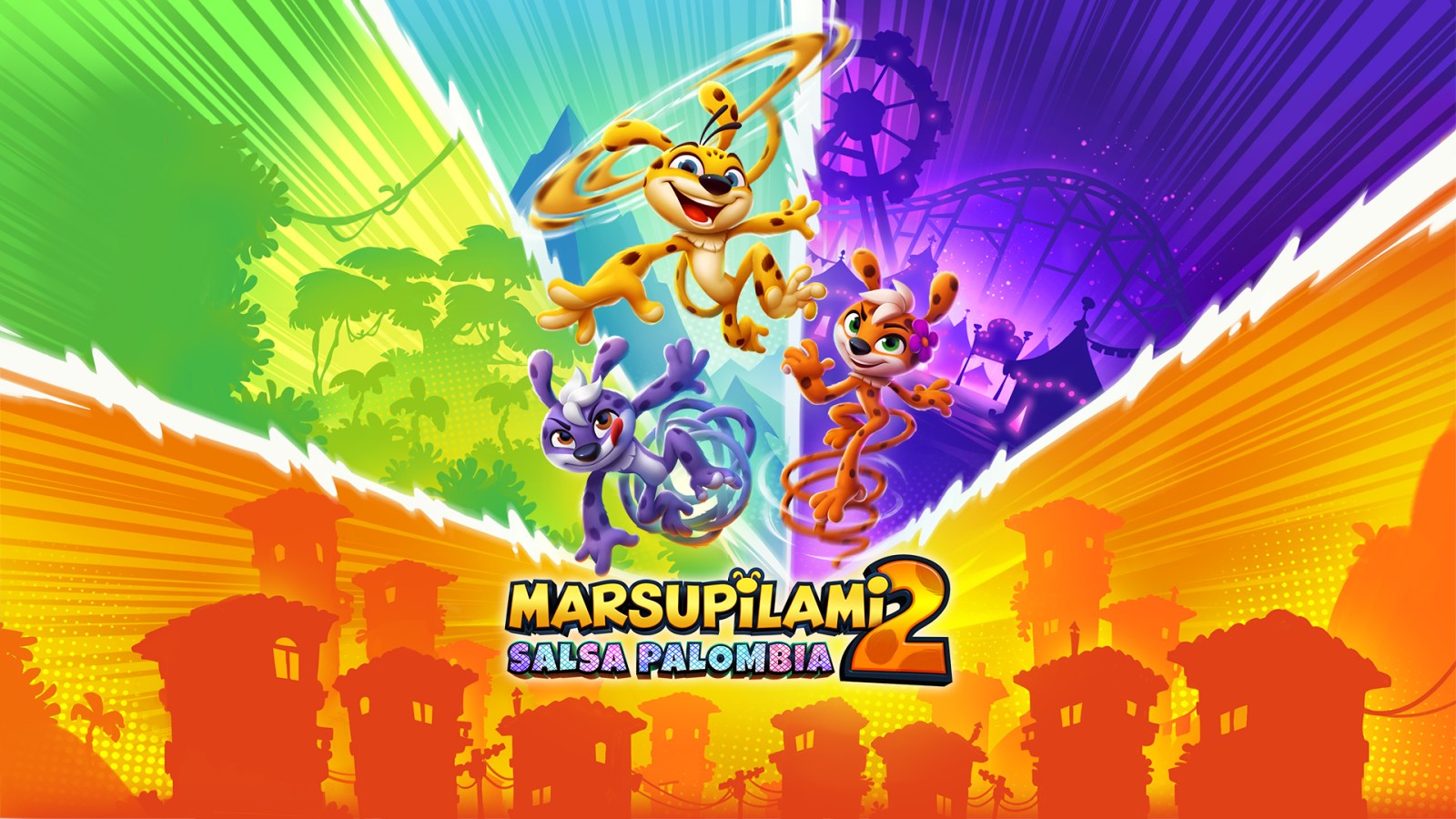
From that eShop description, we learn that the Queen Mummy (or Mummy Queen as both terms are used interchangeably) has returned, alongside her minions from the Land of the Dead. This time around, she’s responsible for a bizarre, hypnotic beat, aiming to host a cursed concert. It’s up to Punch, Twister and Hope, a trio of Marsupilamis, to stop the Queen Mummy in her tracks. Before they can do this, however, they’ll have to make her way through different parts of Palombia and take down her most trusted servants first.
Graphics
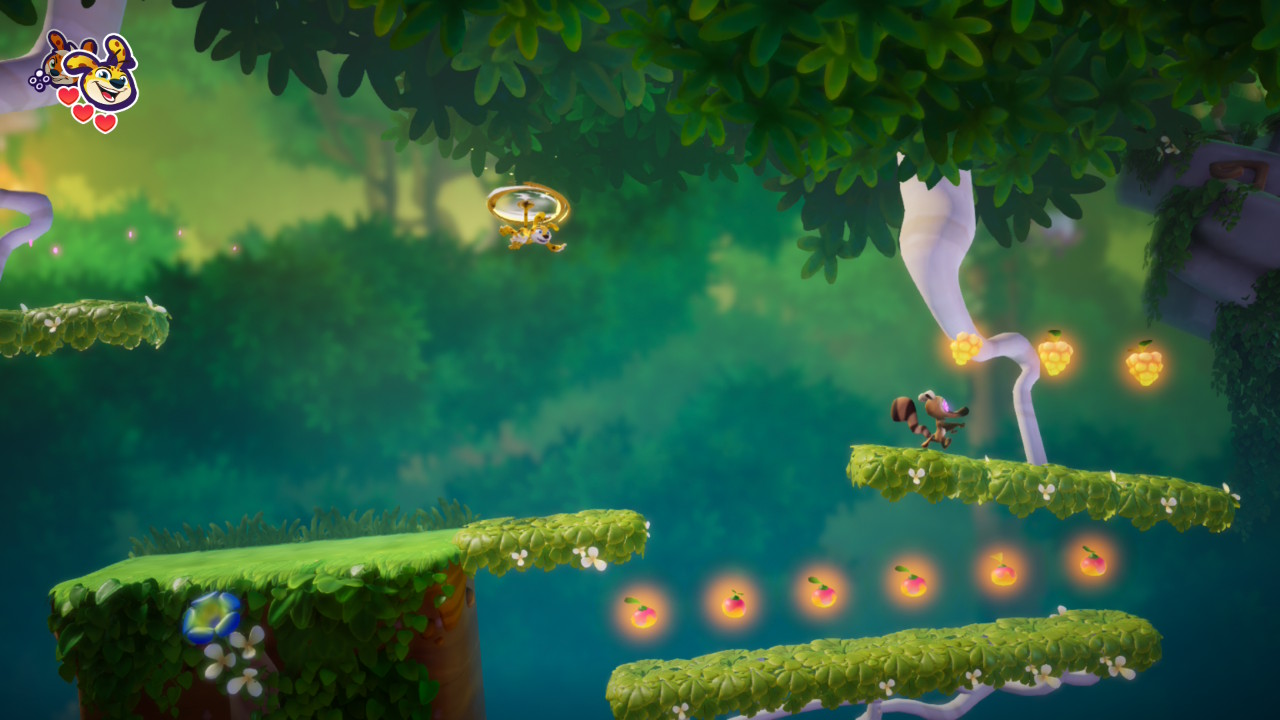
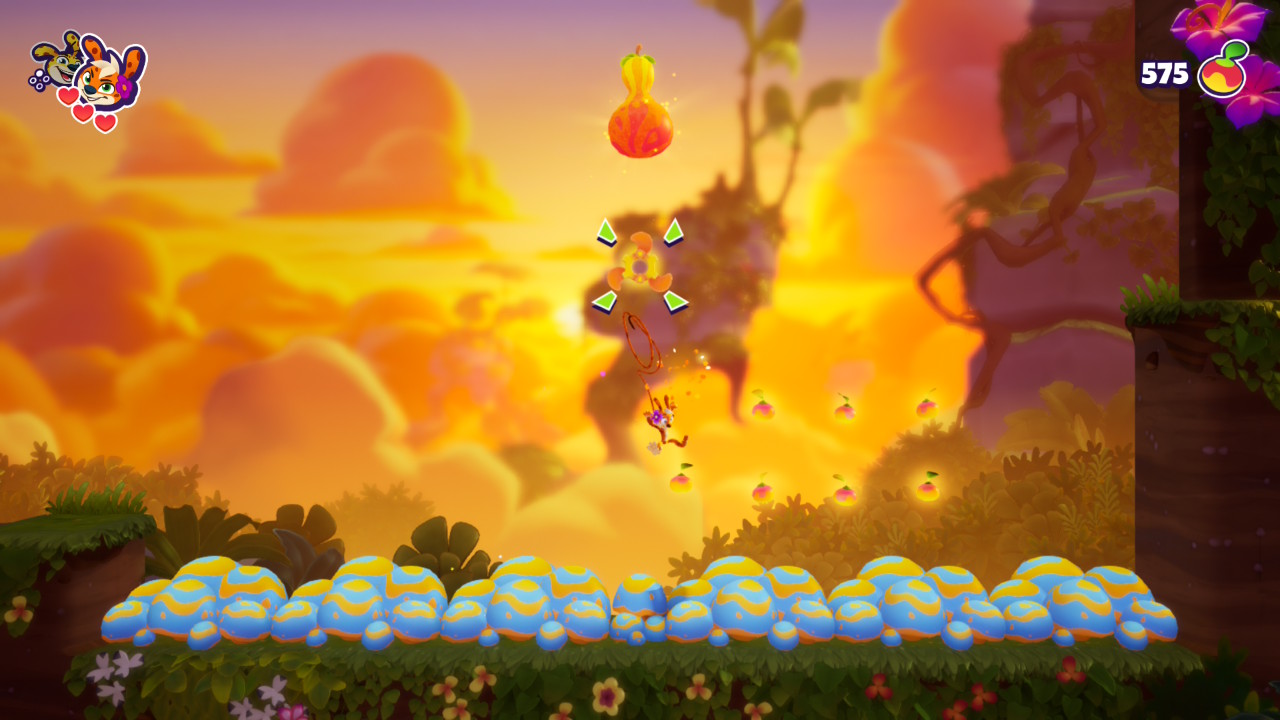
To Salsa Palombia’s credit, the game looks very appealing even if it has little to do with Franquin’s original designs. Environments are colourful and varied, and the enemy designs are creative and feel appropriate for the game’s South America-inspired setting. It’s a bit of a shame that our three protagonists are comparatively bland and lack the personality of the animal that we’ve come to know and love over the decades. Punch and Twister look like palette swaps of one another, and the only thing that distinguishes Hope is the addition of longer eyelashes and flowers on her head. One thing that did irk us about the game’s camera was that it felt zoomed out too much at any given time. A dynamic camera would have been welcome here. On the other hand, visual performance was above average, with no notable stutter and a fairly stable 30 fps frame rate.
Sound
With a game where the central theme is music, you’d expect the soundtrack to be memorable, but unfortunately, Salsa Palombia doesn’t deliver here. While the tunes that you hear throughout the game are at least energetic and fitting for the jungle setting, they lack a real identity and instead come across as generic. Voice acting is mostly limited to our Marsupilami trio’s signature “hooba” and “hop” cries. Perhaps the most notable thing about Salsa Palombia’s soundscape is just how similar the sound effects are to those of (you guessed it) Donkey Kong Country Returns.
Gameplay
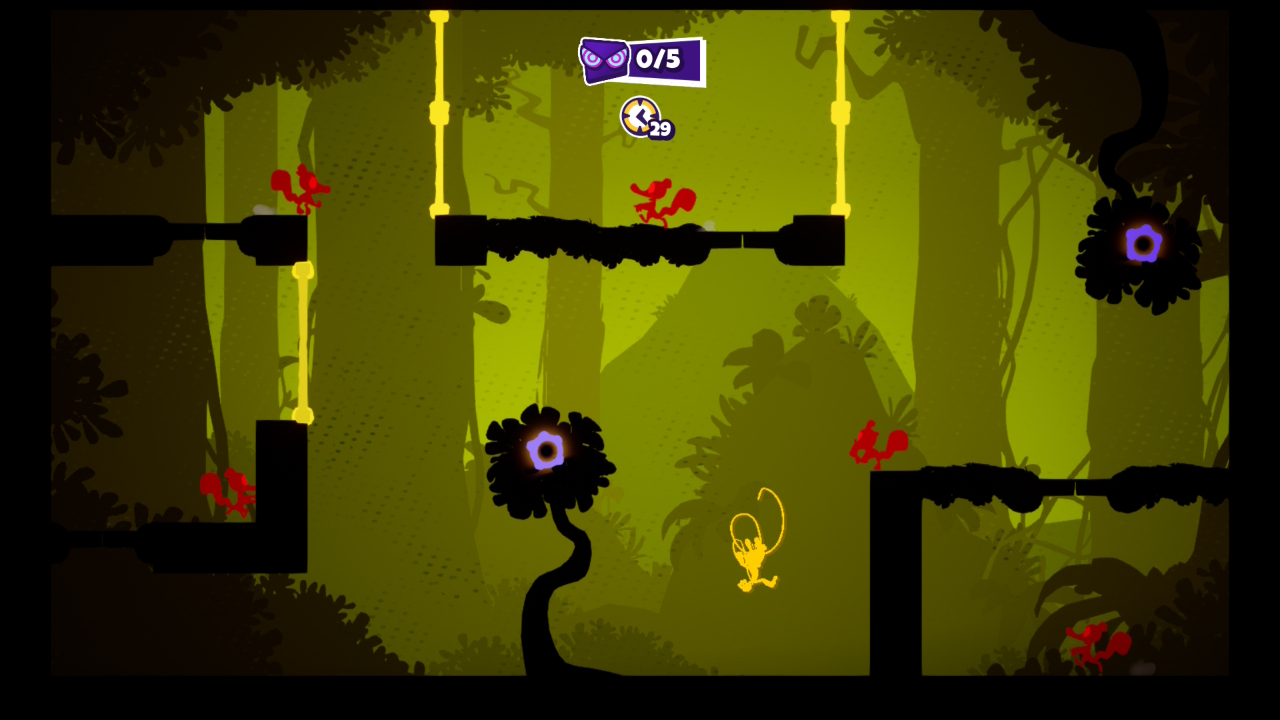
At this point it’s hardly surprising that Salsa Palombia’s gameplay takes inspiration from DKCR as well. What you’re getting here is very much a by-the-numbers 2D platformer where the central gimmick is that you can switch between the Marsupilamis. This is necessary to overcome specific obstacles, as each member of the trio has their own unique ability. Punch can turn himself into a bouncing ball that can destroy obstacles and cross spiky floors, Hope can double jump and Twister is able to glide through the air. It does take some getting used to the control scheme, especially since pressing a button might yield a different result depending on if there is a prompt on screen, but as a whole, Salsa Palombia is a competent, if unremarkable platformer. It’s also very forgiving, as there are lots of checkpoints dotted around the levels, and there is no real penalty for losing a life. That’s not to say that it’s a cakewalk, as some collectibles can be quite difficult to reach.
This brings us to the game’s replay value. Levels are quite lengthy and are filled with secret areas and different items to collect. Your main focus should be music notes, which take the place of DKCR’s KONG letters, and berries, which replace bananas. Completing a level typically cannot be done on the first try, as there is a secondary mode present that ramps up the challenge level. Each level also hides a so-called Battle Dojo, a surprisingly challenging time trial where your Marsupilami abilities are put to the test, so there is plenty for platform enthusiasts to sink their teeth into here. That said, Salsa Palombia does still feel like its aimed at a younger audience. If you’re a parent, you can even team up with your kid in couch co-op or take on one another in the game’s competitive minigames. As a licensed game, Salsa Palombia occupies a similar space as the Paw Patrol or Gigantosaurus games, although aimed at a slightly older audience. At €29.99 digital / €39.99 physical, it sits in that similar price category too, though without an animated series to back it up, we can’t imagine this one reaching a similarly sized audience. It’s a bit of a shame, because even if Salsa Palombia doesn’t shake up the genre, it’s still a solid 2D platformer.
Conclusion
While it’s clear that Salsa Palombia is banking on the cross-generational appeal of the Marsupilami, it doesn’t really do anything with the IP apart from the genericized designs of the main character and mentioning the name Palombia as the country that the creatures hail from. The game lacks the personality of Franquin’s creation and, to be quite frank, comes across as a wholly unoriginal Donkey Kong clone. A well-made clone, mind you, as from a gameplay perspective, Salsa Palombia is a decent platformer. As far as licensed games go, Salsa Palombia definitely isn’t the worst one we’ve played, but it’s not a must-have either.




No Comments