


Developer: Three Bees
Publisher: Three Bees
Platform: PC
Tested on: PC
Perfect Tides: Station to Station – Review
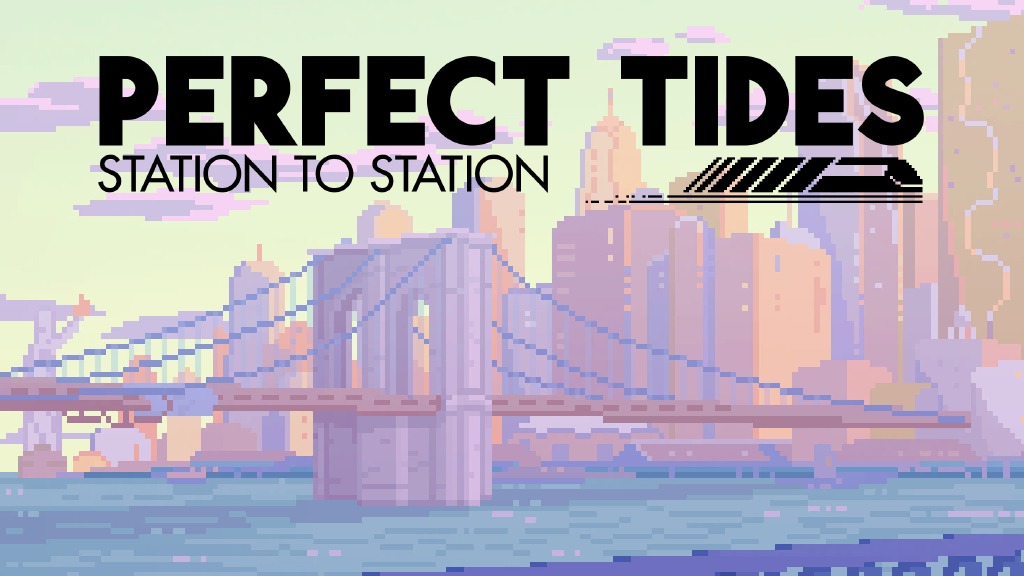
Despite what its title may suggest, Perfect Tides: Station to Station has no connection to Prismatika’s train puzzle game. Instead, this seemingly innocuous point-and-click adventure game is the direct sequel to 2022’s Perfect Tides. Admittedly, that first Perfect Tides game has flown under our radar up until this point, but that’s not going to stop us from seeing just how well Station to Station can stand on its own two legs.
Story
Sometimes a story can be about nothing, and yet, about everything at once. Station to Station is such a story. There is no traditional story arc here, no heroes or villains. Hell, there’s not a true beginning or even an end. Instead, we simply follow 18-year old Mara Whitefish, a freshman at SUCS, a college for creative studies, over the course of roughly one year. Mara’s lens is that of an aspiring writer, and we’re given a deep and extended glimpse into her struggles with anxiety, self-doubt and whether or not she’s going to “make it” and if she is where she belongs in life. It’s a coming-of-age tale that feels aimless, introspective and emotionally raw, yet it’s those same qualities that make Station to Station come across as melancholic, honest and most importantly, deeply relatable.
This is the part where we’d normally warn you about spoilers, but there is very little to spoil here. Nothing ground-breaking happens to Mara, at least not from the perspective of an outsider. It’s as “slice of life” as it gets, but from Mara’s perspective, it’s one life-changing decision after another, whether it’s drinking alcohol for the first time or having an argument on the phone with her emotionally manipulative boyfriend. It’s worth mentioning that the story is set in 2003, not just because of the period-appropriate tech and a slew of references to movies and music from the time, but also because that tells us something about Station to Station’s target audience. Mara’s struggles are universal and will be recognizable for today’s 18-year-olds, but this coming-of-age tale will resonate the hardest with those who were 18 around 2003 themselves. If that’s you, then Station to Station will hand you a nostalgic mirror. Although Station to Station doesn’t offer you an ending in the traditional sense, there wasn’t an ending to your own story when you were 18 either, which is kind of the point.
Graphics
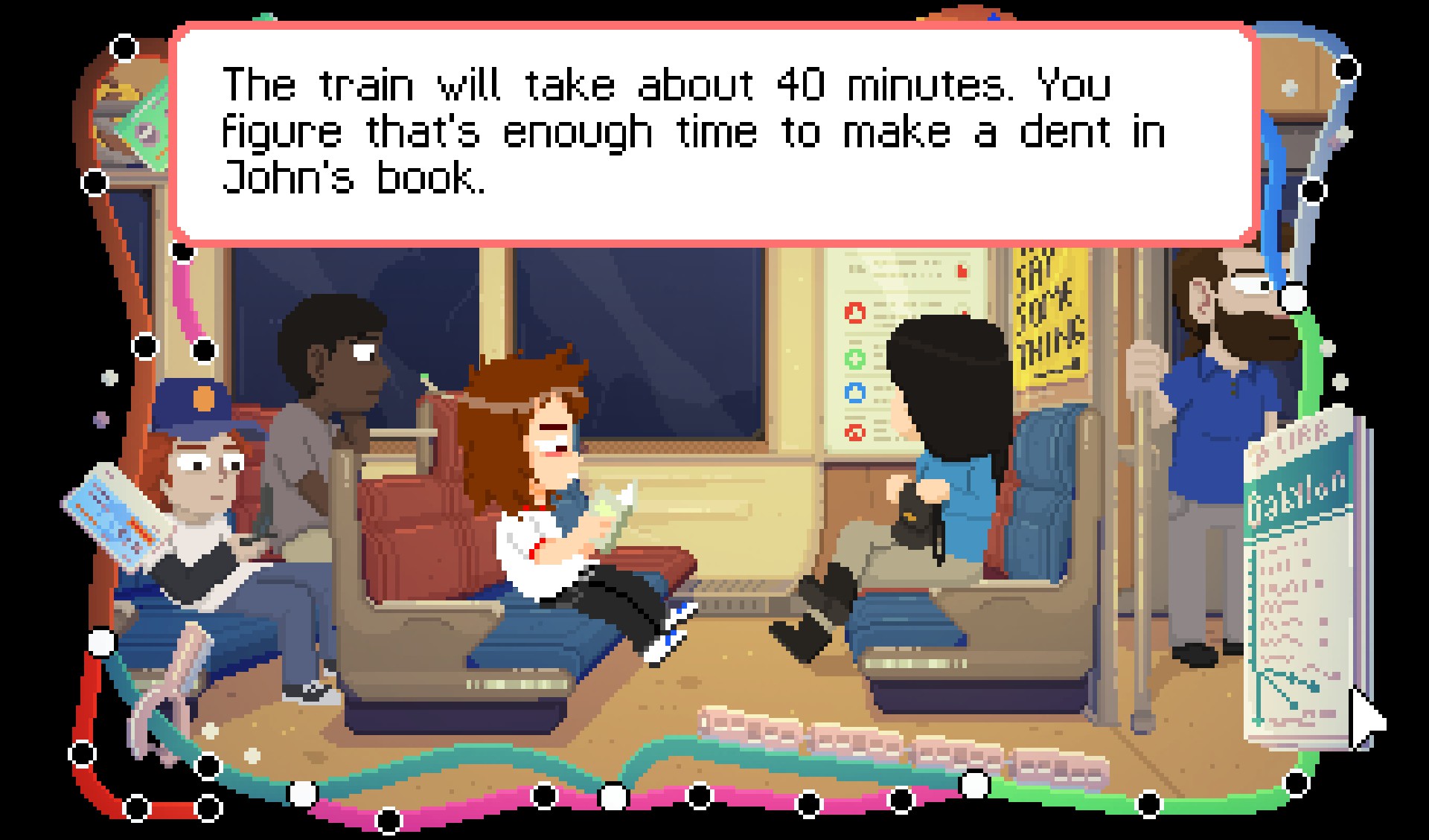
Aesthetically, Station to Station resembles a graphic novel in the vein of the Scott Pilgrim series, albeit rendered through pixel art. Perspective shifts are common, and character designs are strong and expressive. The world that Mara moves in is characterized by lots of visual details and winks to the early 2000s. A pixelated poster of The Matrix hangs on the wall in Mara’s room, and background NPCs are often doing small, humorous things. The animations are choppy, but this appears to be deliberate rather than a performance issue, and it didn’t bother us in the slightest.
Sound
Audio is perhaps Station to Station’s weakest aspect. Not because it is bad, but it is uneven. There is no voice acting present in the game, and sound effects used are functional but nothing more. The biggest issue we had was that the ambience was sometimes conspicuously absent. When Mara walks a street, cars drive by without making any noise, for example. On the other hand, a bar is brought to life by the humming of a crowd. Background music does fit the overall atmosphere, but is ultimately forgettable.

Gameplay
Although Station to Station’s framework is that of a point-and-click adventure game, it doesn’t feel like one. The main focus is on Mara’s story, and it’s up to the player to make decisions that guide her through her college life and shape her as a person. Every single one of those decisions does feel like it matters, but there is no “wrong” way to play Station to Station. You can’t get stuck on a puzzle like you can in a traditional point-and-click title, as life moves forward regardless of whether or not you solve it.
A good example of this happens fairly early in the game: Mara is invited to a party by her acquaintance, Theo. In order to actually get inside the building, however, she’ll need Theo’s full name, which she doesn’t know. There is a specific way to find out that last name, but it’s very missable, leading to the building’s concierge denying Mara access to the party. The way this “puzzle” is resolved feels natural, regardless of whether you solved it or not, highlighting how Station to Station uses its interactive elements as a way to create meaningful immersion rather than pursue traditional gameplay. It’s an approach that works better here than a traditional visual novel format would.

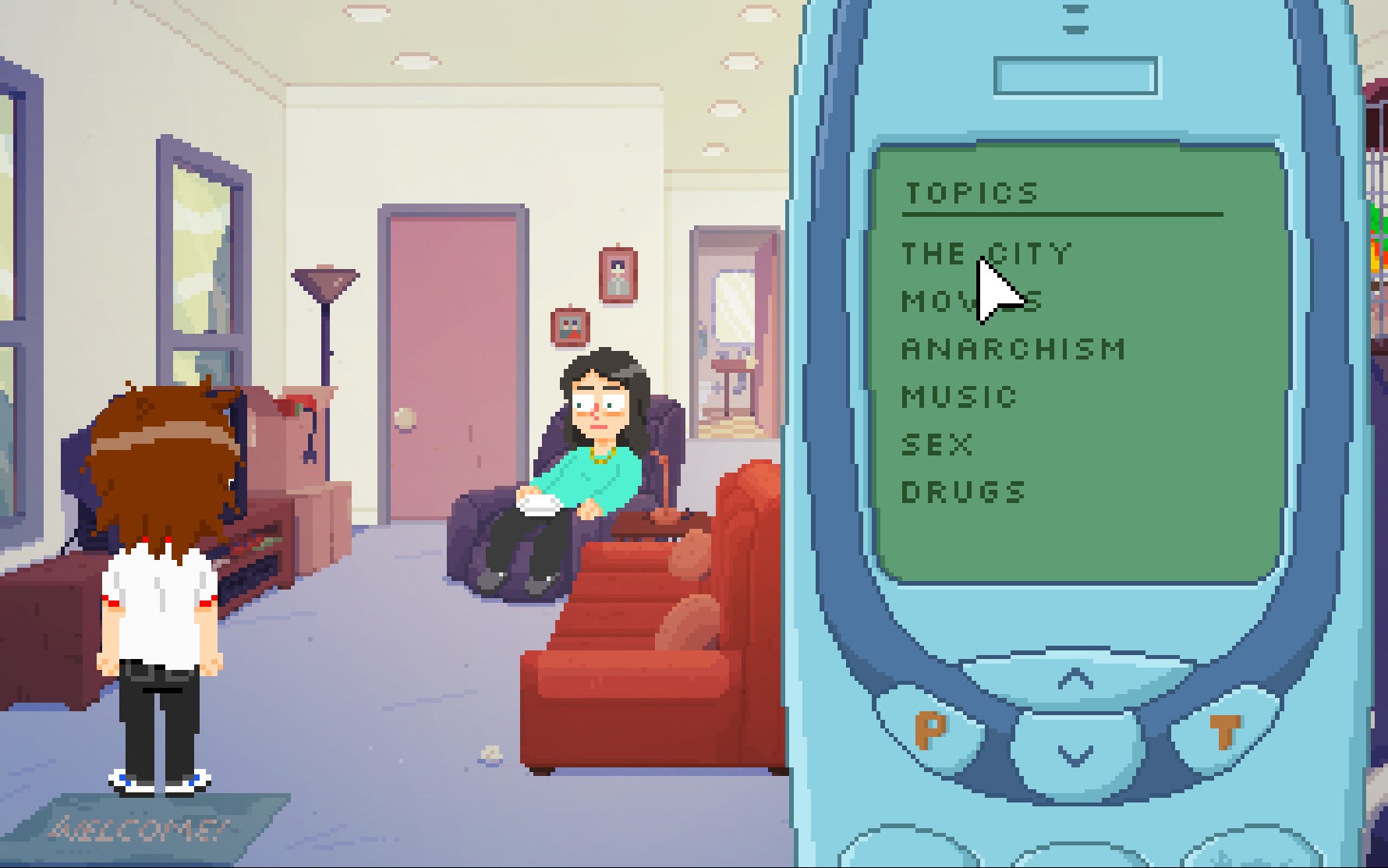
Much of that tactility comes from a deliberately clunky interface and the way early 2000s technology is mimicked. Mara’s brick phone is used for texting and calling, of course, but it also acts as an inventory for conversation topics when talking to other characters. It is most notably not a smartphone. If Mara wants to use the internet, she’ll have to go out of her way to find a PC. From there, she can read and send emails, use Altavista (yes, really) and write essays. The latter ties into Mara’s studies, of course. Throughout Station to Station, she’ll receive different writing assignments, with deadlines, and you’ll need to put aside time to write. Writing is as simple as picking a main and secondary subject from the list of topics on Mara’s phone. New topics are unlocked by talking to people about a variety of things. Sometimes those topics are levelled up, other times Mara actively comments on how it feels like something should have levelled up, but no stat points are gained.
Once the credits rolled, we realized that six hours had just flown by. Part of us wanted to dive right back in, to make different choices, to try different variables. Maybe this time, it would be different. That’s where Station to Station differs from real life. There is no reset button, no “let’s try this again”. We ended up actively deciding not to give this one another playthrough for the time being. Not because it doesn’t deserve it. In fact, we already know that we will be returning to Station to Station sooner rather than later. No, we wanted to let that first playthrough sink in. Station to Station is one of the most poignant titles we’ve played in a long time, and we should let that feeling linger.
Conclusion
Less of a traditional game and more of an immersive storytelling experience, Station to Station truly is something special. It perfectly captures those feelings of aimlessness and self-doubt we’ve all experienced just as we outgrew our kiddie shoes. It’s the kind of game that can’t be fully explained without experiencing it for yourself, and so we urge you to simply go and download it. Right now. What are you still here for? Now, if you’ll excuse us, we’re going to go and add that first Perfect Tides game to our library.

Related Items




1 Comment
Leave a Reply
You must be logged in to post a comment.
[…] 2024’s Mining Mechs, a game we somehow also missed. Who knows, maybe Super Mining Mechs pulls a Station to Station and gets us invested enough to check out its predecessor. Did we dig Super Mining Mechs, or should […]