


Developer: Nicolas di Costanzo
Publisher: 3Goo
Platform: PS5, PC, Switch (2)
Tested on: Switch 2
4PGP – Review
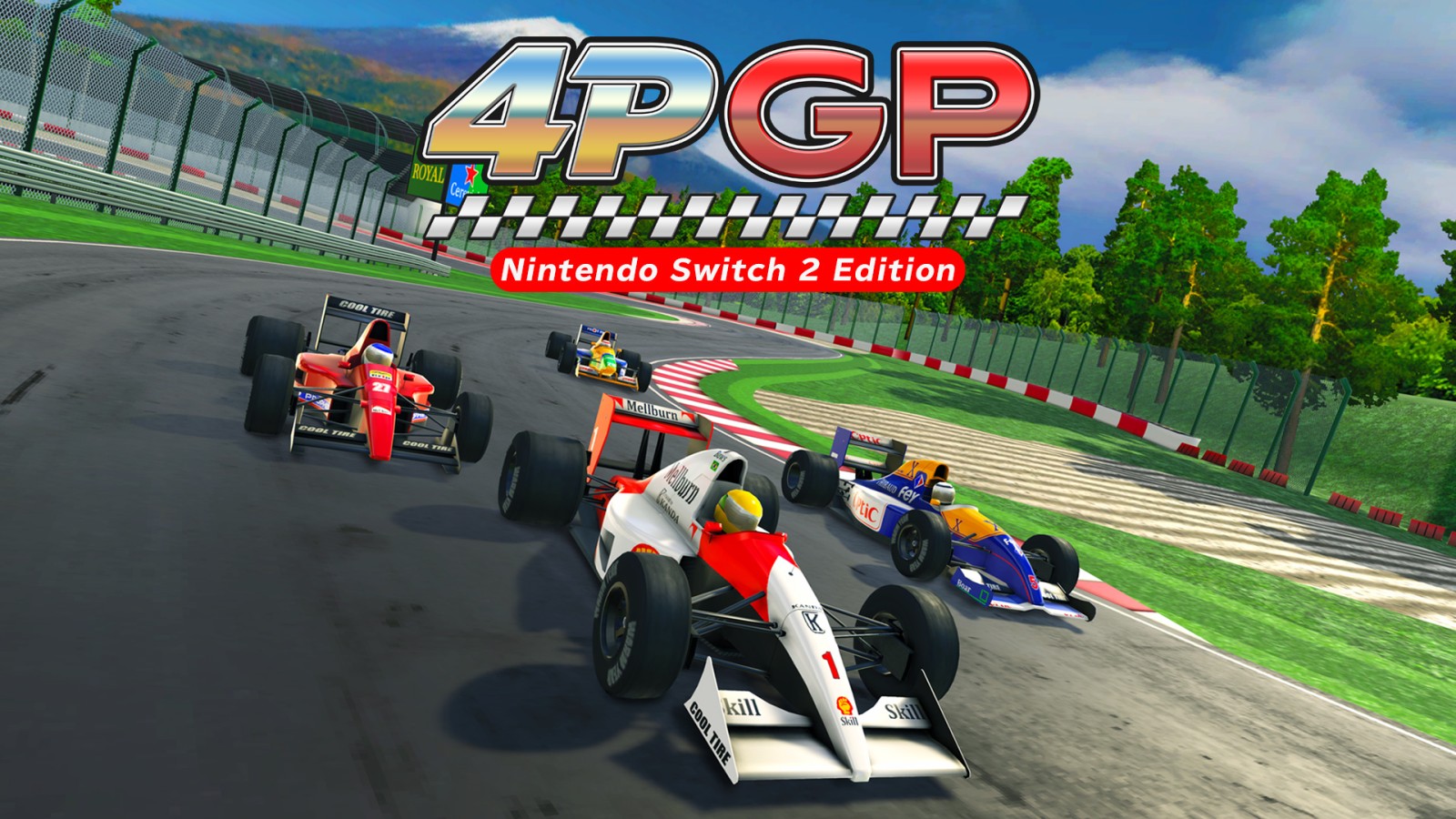
If you grew up in the ‘90s, you’ll undoubtedly remember encountering arcade machines in the wild without having any money on you. So, being a kid, what did you do? You pretended that you were playing it, as the game’s demo footage played with the words ‘INSERT COIN’ flashing on top. 4PGP looks and feels like one of those rogue arcade games you’d run into at an airport terminal or in a restaurant. The difference is that this time, you don’t need coins to play it, and you can let your inner kid run wild.
Story
Being a pure arcade racing game, 4PGP does not feature a narrative. There is no career mode, story mode or character dialogue. The premise is as generic as its unlicensed, legally distinct lookalike F1 vehicles. The closest thing you’re getting to a story is that its fictionalized circuits share their names with real-world locations from across the world.
Graphics
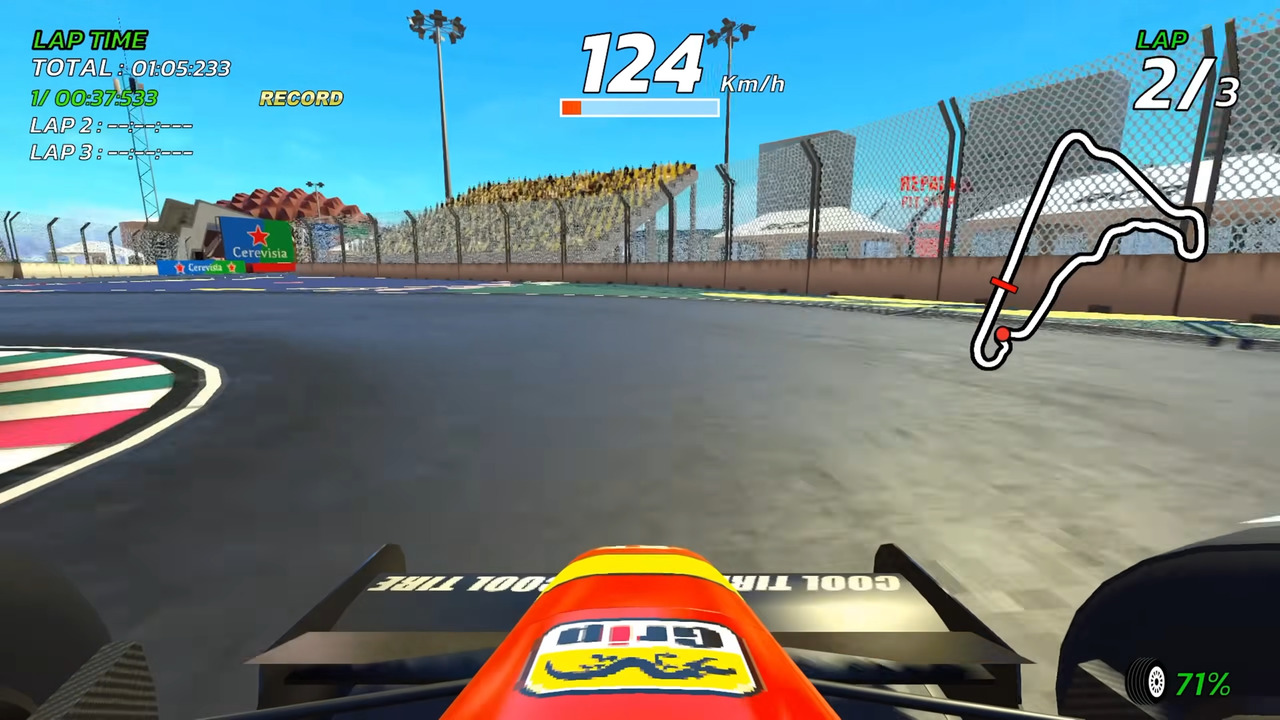
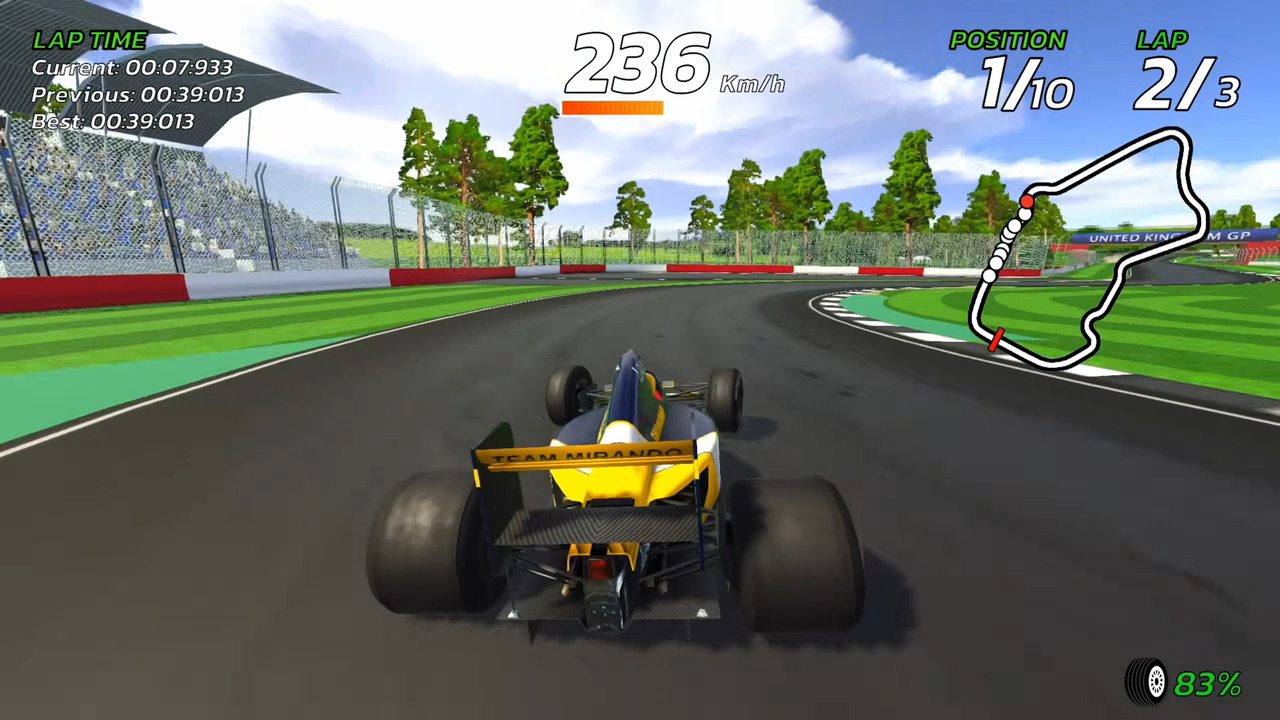
If you distilled every ‘90s arcade racer’s visuals, the end result would probably look remarkably similar to 4PGP. We mean this in the best way possible because the game’s bold retro aesthetic and polygon-style visuals instantly made us nostalgic. The bright, saturated colours unapologetically embrace the era-specific blue sky aesthetic. Environments are just as varied as the cars, spanning deserts, neon-lit cities, coastal highways and classic GP arenas. There are visual quirks that would irk us elsewhere, like poor anti-aliasing and texture filtering, and highly noticeable pop-ins, but they feel appropriate here, as they remind us of the limitations of a bygone era. In terms of performance, 4PGP does feel a lot more modern, running at a very stable 60FPS and up to 120 FPS on monitors that support it. Additionally, the game’s resolution supports up to 4K.
Sound
We can’t be as forgiving of 4PGP’s audio as we were about the game’s visual quirks. While Tomoyuki Kawamura’s soundtrack is generally great, the way it is implemented in the game isn’t. Music only plays in menus, briefly whenever you cross start/lap lines and during a final lap, meaning that during the majority of a race, you’ll only hear your engine noises. Those noises can get really grating too, especially during prolonged play sessions, making 4PGP’s soundscape one of the game’s weakest points. Voice acting is expectedly absent.
Gameplay
Rather than aiming to reinvent the (racing) wheel, 4PGP offers a simple, to-the-point throwback F1 experience. Controls are deliberately simple: the A button lets you accelerate, the B button acts as the brake and the L button activates your turbo mode. A brief tutorial takes you through the notions, and then you’re ready to compete across three-race Championship cups, Quick Races and Time Attacks. Success in these modes unlocks additional tracks and cars. Accessibility is one of 4PGP’s stronger suits, with steering assists, brake stabilizing and gyro controls all baked into the game. Younger and novice players will find that it won’t take very long to find their footing. Veterans and retro enthusiasts will still find plenty to chew on here though. Most importantly, that inherent simplicity felt authentic and took us right back to our childhood.
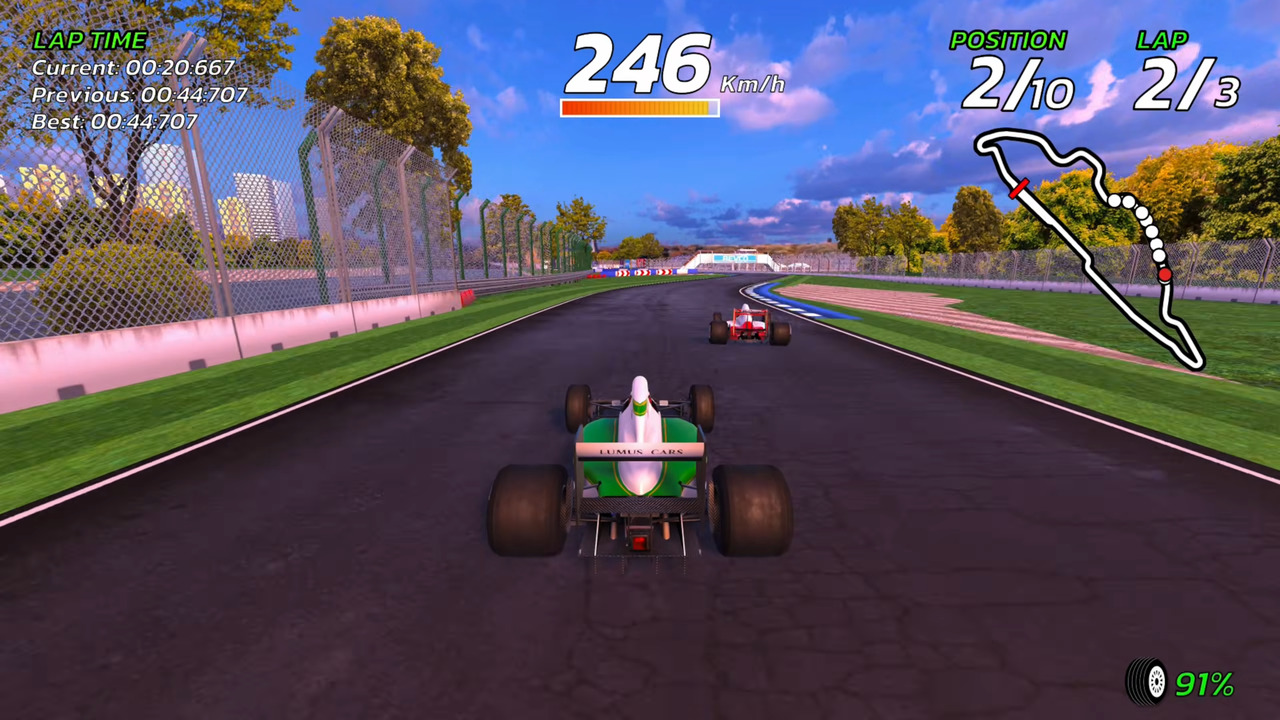
That isn’t to say that 4PGP is an easy game. Far from it, in fact. The game’s single-player experience, especially at higher difficulties, really does come across as challenging, not in the least because of the game’s unforgiving AI opponents and reverse rubber-banding. The key to success is tied to mastering the Turbo Boost. You only have a limited amount of Turbo available, but you can replenish this by driving over a pit-strip. If you can hit a QTE button prompt while doing so, your meter is instantaneously refilled. This is 4PGP’s defining mechanic, as manual gears, analogue acceleration or car adjustments are simply omitted. Cars are mega-grippy too, with a heavy emphasis on maintaining speed and choosing correct racing lines rather than drifting.
The 4 in 4PGP stands for four players, as the game supports local multiplayer, either split-screen or via GameShare. Multiplayer is probably 4PGP’s best feature, as it avoids the more frustrating issues like that reverse rubber-banding that plague the game’s higher difficulties. This is also where 4PGP’s longevity comes into play, as once the single-player championships are cleared, which takes around 3 hours, you’re limited to unlocking cars, chasing ghosts in Time Attack or playing with friends. 4PGP is light on content, especially for that €24.99 asking price (€19.99 on Switch 1, but without that resolution and frame rate). Then again, this is an arcade title first and foremost, and being light on content typically isn’t a bug, but a feature for those.
Conclusion
You’ll need to approach 4PGP with a very specific mindset to truly appreciate it. By modern standards, this is simply a flawed game. However, as a love letter to ‘90s arcade racers, those same flaws actually add to the nostalgic feeling that the game tries to evoke. If you can stomach the €24.99 price, then invite over some of your friends, grab some childhood snacks and drinks and relive those bygone years with 4PGP.





No Comments