


Developer: Winter Crew Studios
Publisher: CMD Studios
Platform: PC
Tested on: PC
Fallen Tear: The Ascension – Review
Six months ago, when we sat down with Fallen Tear: The Ascension in Early Access, we were impressed by the game’s heart. Winter Crew Studio’s debut title was well on the way to becoming a beautifully crafted, character-driven Metroidvania game, leaning heavily into its JRPG roots through its clever companion system. At the same time, we couldn’t ignore its early rough edges: tedious backtracking, unrefined progression menus, and an erratic boss balance. With the 1.0 release officially making its way to Steam, we’ve returned to the now-complete land of Raoah. Can the full release live up to that early ambition?

Story
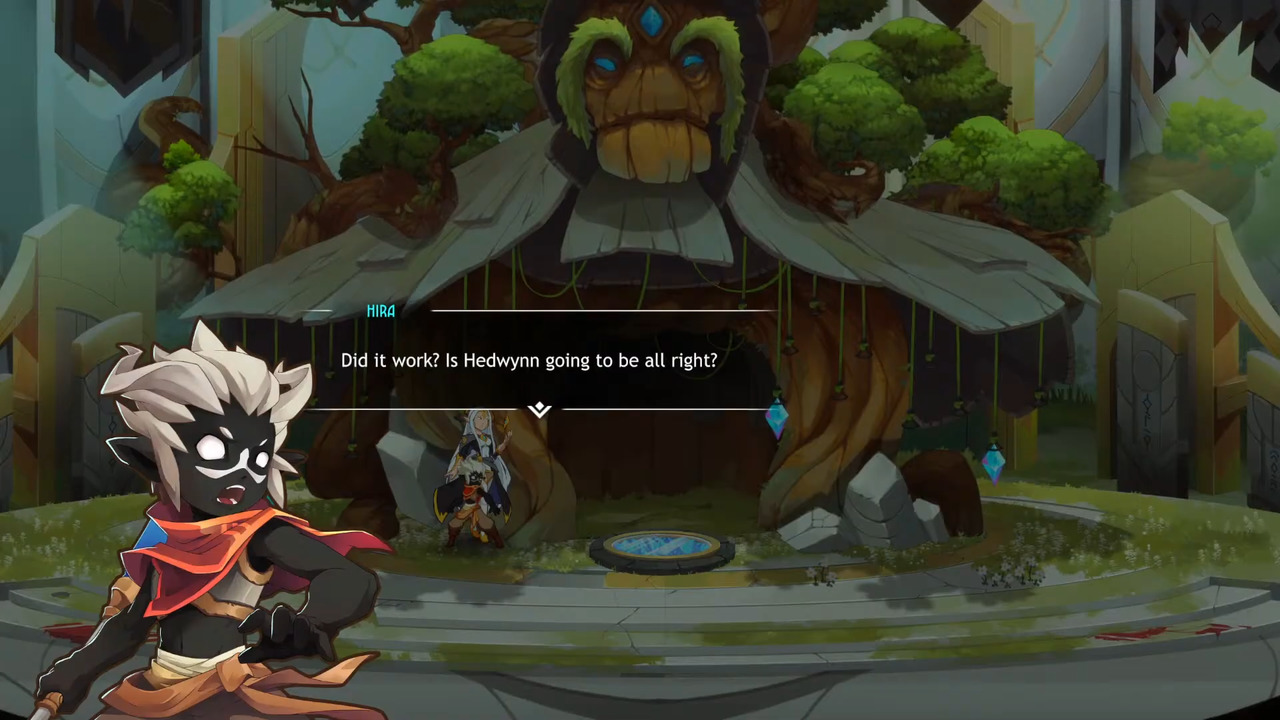
The overarching narrative of Fallen Tear sticks to familiar tropes, but it serves its purpose well. You take on the role of Hira, a young boy raised in a quiet village. There is more to him than meets the eye, as dark powers are dormant inside him. When demonic monsters destroy Hira’s hometown, his mother entrusts our hero with a mysterious artefact that can reactivate ancient technology. Hira must travel across the land of Raoah to cleanse the corruption caused by the elemental Gods themselves. The main plot of Fallen Tear takes a backseat to the action, with the game’s narrative strength lying in its cast. The world of Raoah feels alive thanks to the eclectic cast of characters Hira meets along the way. The game’s writing puts a heavy emphasis on character relationships. Rather than acting as simple exposition dumps, your allies have genuine arcs that form the emotional core of Hira’s adventure. You can dig even further into Fallen Tear’s lore if you want as there are 50 hidden ancient texts scattered across Raoah that add depth to the setting.
Graphics
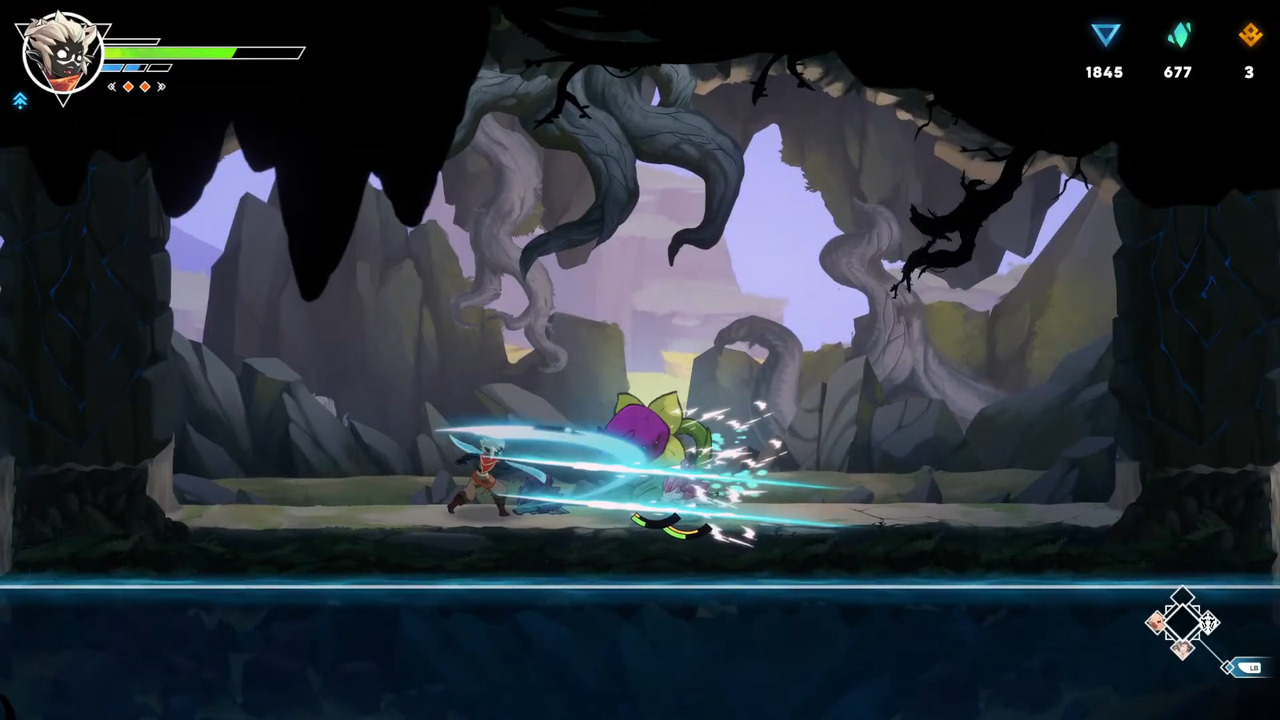
Visually, Fallen Tear remains nothing short of a feast for the eyes. The hand-drawn aesthetic brings over 20 distinct biomes to life, spanning frozen mountain peaks, lush verdant plains, and desolate deserts. The level design makes great use of layered, colourful backdrops. The striking character designs are brought to life through remarkably fluid animations. Where Fallen Tear’s visuals stumble ever so slightly is when it comes to at-a-glance readability. Biomes like the Lilac Mire restrict your field of view to a tiny circle of light around Hira, making navigation a chore in this area. Additionally, the camera sometimes struggles to keep up when you’re moving rapidly upwards or downwards across the levels.
Sound
The sound design complements Fallen Tear’s atmosphere nigh on perfectly. Accompanying your journey is a dynamic orchestral soundtrack that sets a quiet, peaceful tone while you’re exploring and ramps up nicely during frantic combat encounters. The game also features full voice acting for its key characters, providing the core cast with distinct personalities and elevating the overall writing.
Gameplay
The foundation of Fallen Tear’s gameplay is that of a solid Metroidvania. However, the game isn’t afraid to break away from the familiar genre formula and introduces some unique mechanics. The main one that sets the game apart from other Metroidvanias is the Fated Bond System. Over the course of your journey, you can recruit up to 22 companions. Three companions can be assigned to act as active bonds for Hira. Once bonded, they can be summoned into battle for specialised attacks and passive buffs, like Bjorn the Chef tossing a hot pan for extra damage while permanently boosting Hira’s HP, for example. This sets the tone for something that permeates Fallen Tear’s gameplay: customisation. The game is as open-ended as it is massive, and the way you build Hira shapes how you explore Raoah. That also means that it’s unlikely that your journey will be the exact same as ours. Given that backtracking is inherent to the genre, we’re happy to say that Fallen Tear has taken a page out of Prince of Persia: The Lost Crown’s book, allowing you to take a picture of an obstacle and pin it to the map. This makes remembering where to backtrack to a breeze, even if the map itself could still use a few more custom icon markers for specific wall types.
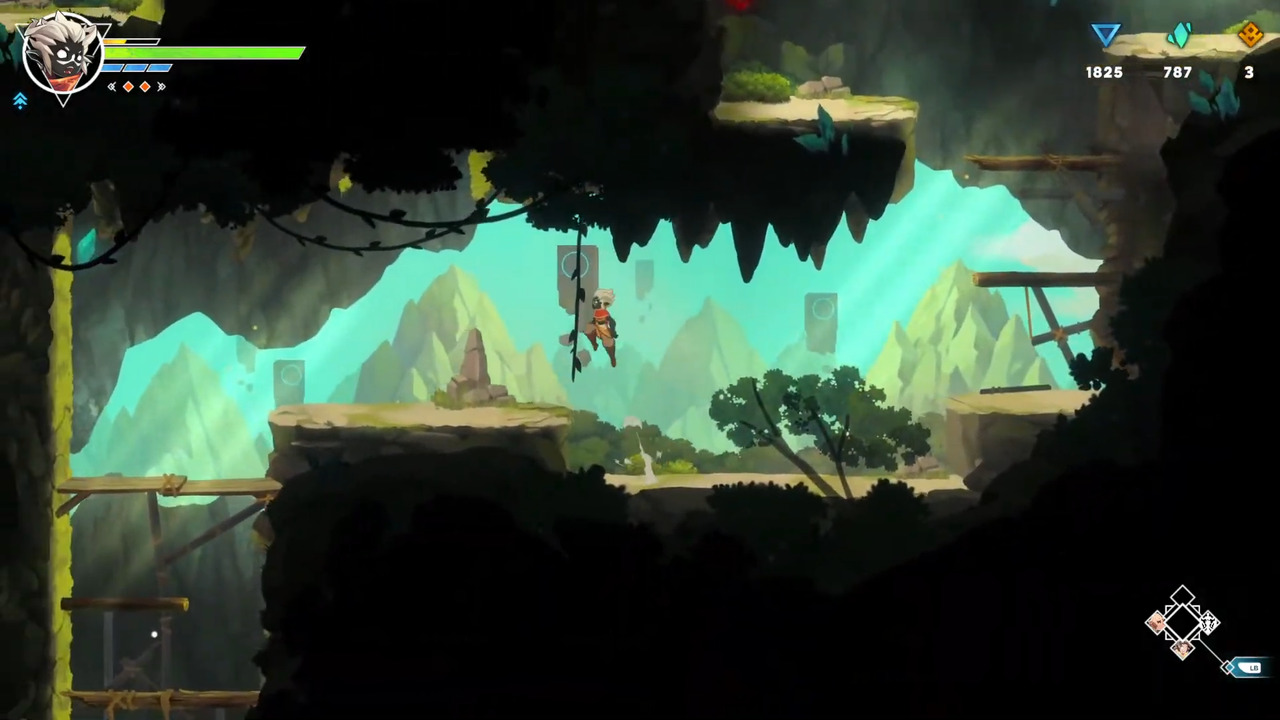
In typical Metroidvania fashion, there are plenty of unlockable traversal abilities for Hira, including double jumps, air dashes, and ground pounds. However, the way you obtain these differs from what you’d expect for the genre. These abilities, called Ascensions here, are tied directly to earning Bond Points, rather than defeating specific bosses. You can head to a temple and unlock them in whatever order you choose. You can even attach elemental affinities to Ascensions to add offensive flair or extra range. Oddly enough though, you’ll only need 14 Bond Points to unlock the available Ascensions, but there are 22 available in-game, leaving 8 extra points with no functional reward, which does feel like an oversight. Beyond Ascensions and Fated Bonds, you can further tailor Hira’s raw stats to your preferred build by collecting chests. Finally, Fallen Tear boasts a robust achievement system, the so-called Fated Goals. The Fate Points you collect from this system can be spent on a multi-tiered Mastery skill tree. Our only grievance with this system is mechanical: you have to manually open menus to turn in these achievements, which interrupts the game’s flow.
It’s not Fallen Tear’s biggest gameplay flow. That dubious honour still lies with the game’s structural balancing. The focus on customisation and freedom is a double-edged sword. Because progression is so open-ended, it’s easy to wander into high-level areas unprepared and get pulverized. Boss difficulty in particular is wildly inconsistent, with some early encounters and mini-bosses hitting far harder than late-game bosses, while others, such as Mechalevizz, felt like tedious damage sponges. Add in sparse fast-travel points (yes, still), platforming gauntlets with insta-kill hazards and random events that suddenly buff all enemies in the world, and exploration can occasionally turn frustrating. Don’t let that deter you from giving Fallen Tear a go if you’re a hardcore Metroidvania enthusiast. The game may be harder than you’d expect, but it makes actually achieving what you set out to do all the more satisfying.
Conclusion
The full version of Fallen Tear: The Ascension is a title where the sum is greater than its individual parts. Winter Crew Studios set out to create a sprawling, party-driven Metroidvania, and on many fronts, they succeeded brilliantly. The Fated Bond system brings a fresh JRPG flavor to 2D action, and the hand-drawn world of Raoah is a joy to behold. However, the game is dragged down by pacing and balance issues that feel unrefined. Uneven boss fights, tedious menu redemptions, sparse checkpoints, and awkward fast-travel distribution hold it back from reaching true genre royalty. If you’re a Metroidvania diehard looking for a huge, open-ended world with deep customization and great narrative flavour, Fallen Tear is well worth your time and money.



No Comments