

Developer: ByteRockers' Games
Publisher: ByteRockers' Games
Platform: PC
Tested on: PC
Solnox: Grimoire of Seasons – Review
The roguelite deckbuilder genre isn’t exactly short on competition. In fact, genre enthusiasts are so spoilt for choice that a newcomer really needs a standout idea to compete with the likes of Slay the Spire or Balatro. Solnox: Grimoire of Seasons certainly has such an idea, with its combat system built around the changing of the seasons. Is it a good idea enough to keep Solnox in season?
Story
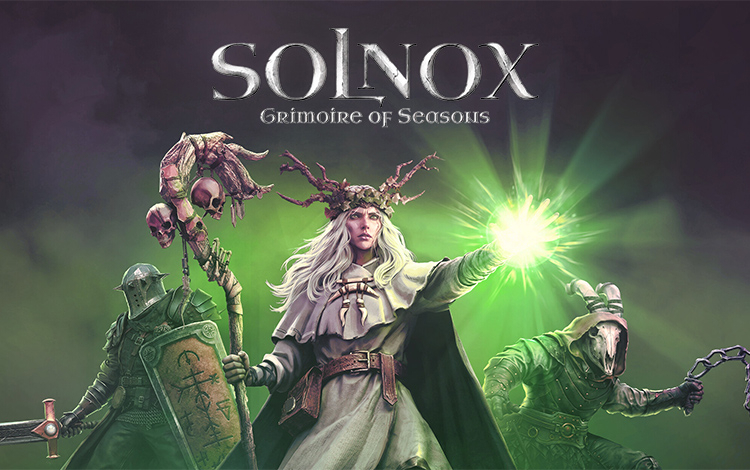
While there is a story present in Solnox, it serves as little more than window dressing. The premise revolves around a traveling party of three powerful Wardens: Cormac the Crusader, Morwenna the Mage, and Fenric the Rogue. They serve as the last line of defence against the so-called Last Season. The latter is an apocalyptic supernatural force, which is overrunning nature and spreading across the world, corrupting animals and turning them into unholy creatures. You only control one of the three Wardens at any given time, with the non-active party members feeling irrelevant as they don’t contribute anything when you’re actually playing. Even within its limited scope, the narrative fails to adapt to whichever Warden you select, lacking class-specific dialogue or unique story outcomes. Unsurprisingly, there is a disconnect between story choices and subsequent character actions as well. Ultimately, it’s probably best that you simply don’t pay any mind to Solnox’s narrative because there is very little of value here. What little story there is feels like it’s only included because ‘you need to have a story in your game.’
Graphics
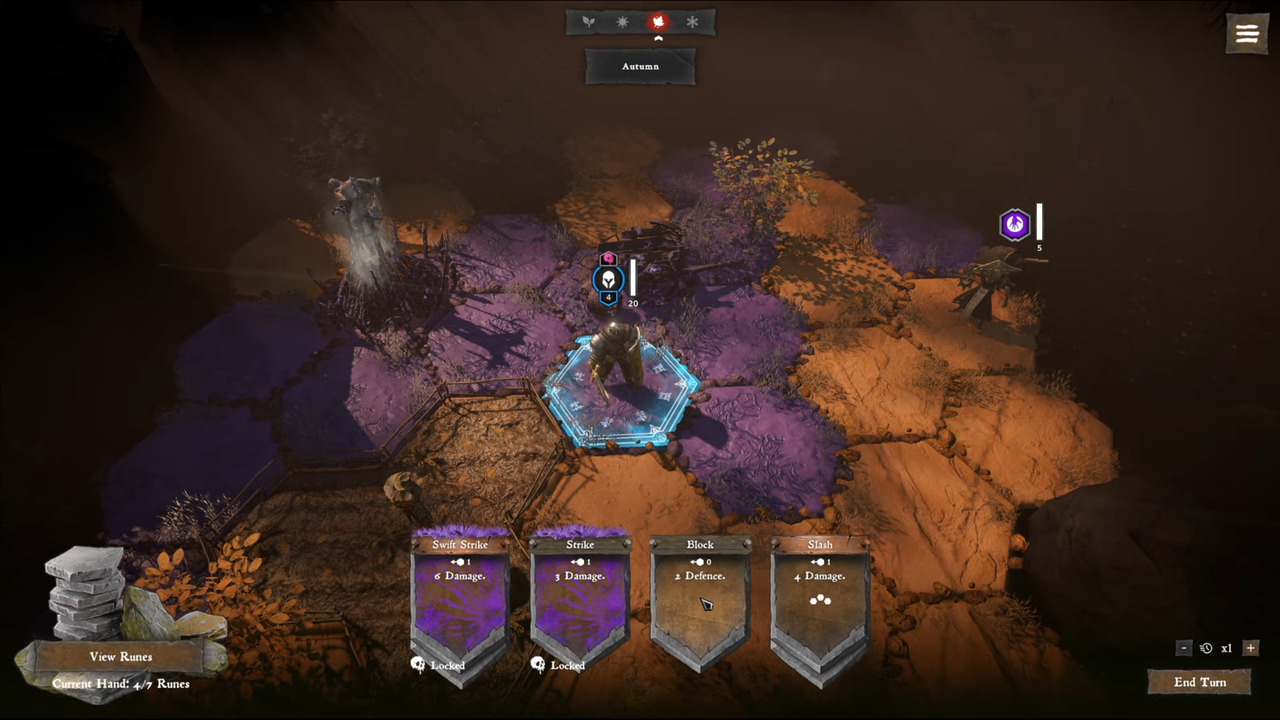
A similar thing occurs with Solnox’s visuals. They’re functional, but lack an actual identity. The dark fantasy aesthetic simply falls flat, with simple textures and plain-looking designs for characters and enemies. Bosses don’t even look different from standard enemies, aside from being bigger. The game simply lacks the variety needed to keep things visually interesting for more than five minutes. It doesn’t help that the animations aren’t the most fluid either. To Solnox’s credit, the lack of visual splendor does make for a very readable game, with a clean UI and no distracting visual clutter. In terms of visual performance, we did run into the occasional graphical bug, including card animations that temporarily turned invisible and an unruly camera that failed to auto-center on our character during movement.
Sound
We’re going three for three with Solnox’s soundscape: the game’s music is functional but forgettable, failing to establish the strong foreboding atmosphere needed for the game’s dark fantasy setting. Sound design in combat is sparse and competent at best, with uninspired sound effects and a lack of celebratory sound cues when it comes to things like defeating bosses. There’s also a complete absence of voice acting, although at this point, we’re not surprised, just disappointed.
Gameplay
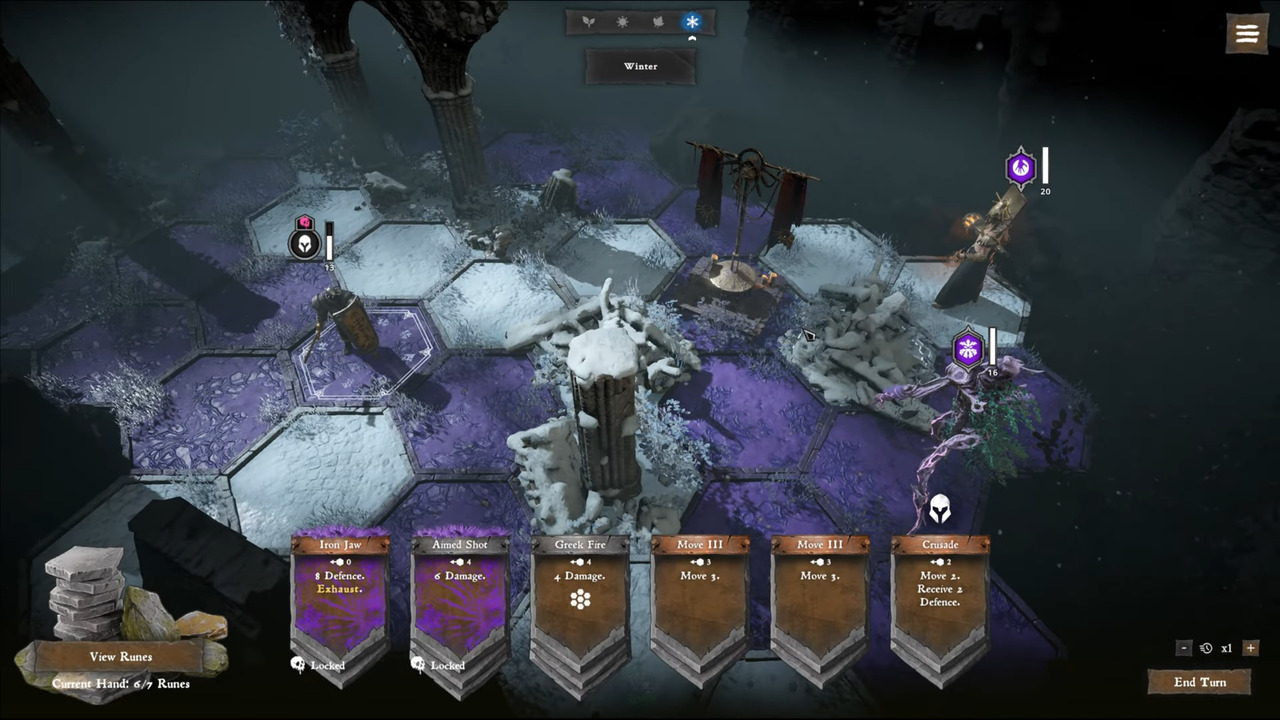
With Solnox’s narrative and audiovisual presentation acting as little more than a framework for its roguelite deckbuilding gameplay, that gameplay really needs to knock it out of the park to make the game worth adding to anyone’s library. Unfortunately, the game disappoints here as well, though not because its core mechanics are bad. In fact, there are quite a few good ideas in the base system, but the game is plagued by poor balance, bugs, glitches, and a general lack of polish. We’ll get to those issues, but first, let’s take a look at what Solnox tries to do. Its core gameplay loop is familiar enough: a branching map structure lets you select paths consisting of shops, battles, rest nodes and mysterious zones where you tinker with your deck. Battles take place on small hex-grid battlefields where spatial positioning and range play a pivotal role. Rather than mana, the game works with a rune-based system, where you draw 6 runes per turn. Unused runes carry over, but your hand capacity remains capped at 6, forcing hand management across turns.
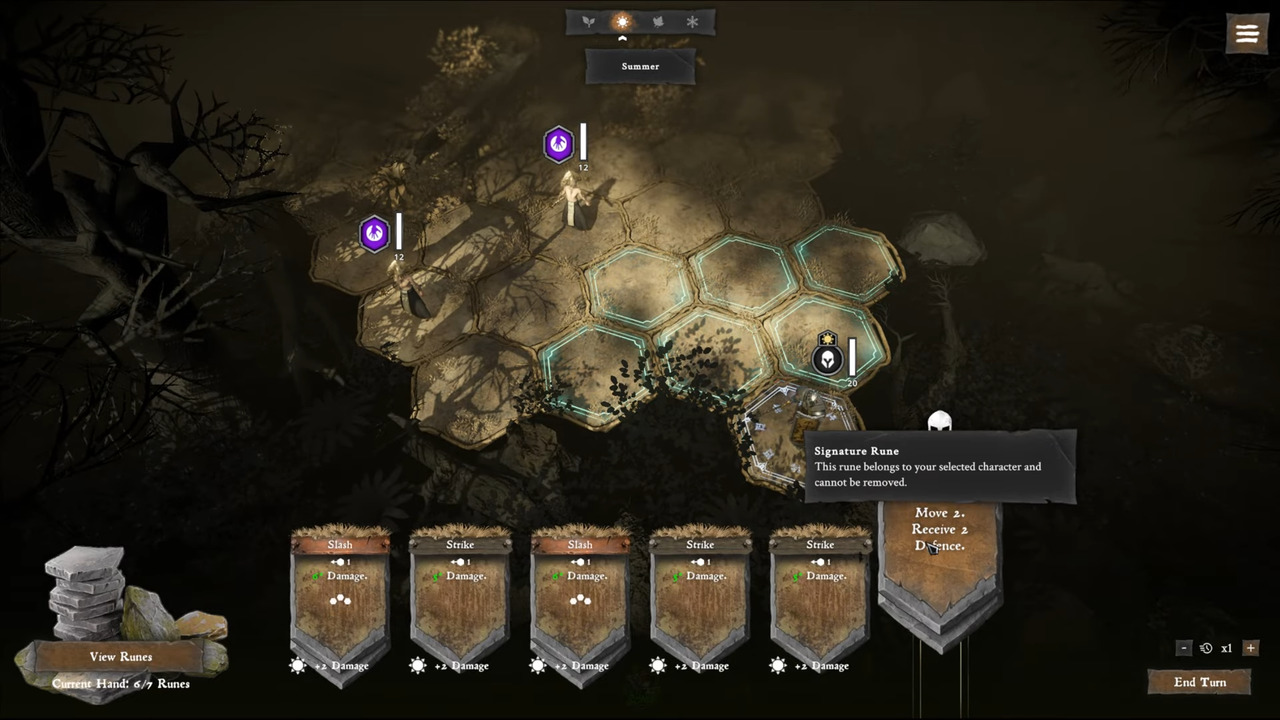
The game’s unique mechanic sees seasons rotate automatically every turn, applying specific modifiers to your runes and actions. Winter boosts your armour, for example, whereas autumn increases your movement range. The constantly shifting battlefield conditions add unique tactical depth, especially later on in the game where you can manually manipulate seasonal tile effects. Each of the three Wardens has their own playstyle, with Cormac acting as a tanky bruiser, Fenric relying on displacement and positioning tools but lacking defensive block abilities, and Morwenna casting ranged spells but being vulnerable up close. Combined with the various in-game difficulty levels, this makes for a game that, in theory at least, has plenty of replay value.
Where Solnox starts to falter is balance. Higher difficulty levels simply scale up enemy health and damage rather than altering the rune system or season mechanics, making for battles that become repetitive at best and outright grindfests with little margin for error at worst. Late-game bosses simply start to wear you down over time rather than actually challenging your skills. To make this worse, enemy animation speeds cannot be sped up, making battles a chore to sit through. Environments lack functional cover, with objects on the battlefield merely blocking movement paths rather than providing tactical environmental cover. As for those aforementioned glitches, we noticed that runes become unselectable while attack animations play, which led to misclicks when we were putting in commands too quickly. There were also several instances where the game would completely freeze on us, forcing us to restart and lose our progress in the process. These are issues that could probably be fixed with a patch or two, but as it stands, they hurt the game just enough for us to not recommend Solnox, not even for its low RRP of €6.66 (get it?).
Conclusion
On paper, Solnox: Grimoire of Seasons’ unique season-based combat system has plenty of potential. In practice, the game is very, very lackluster. From the functional-but-generic audiovisual presentation to the poorly implemented narrative to the unbalanced gameplay, this is a game that we simply can’t recommend. The first priority the developers should have is to fix the game’s bugs and glitches, but even if these were patched out overnight, we’re still not sure whether or not there is enough of worth here.





No Comments