


Developer: Monster Couch
Publisher: Monster Couch, Cardboard Alchemy
Platform: Switch (2), PC, PS5, Xbox Series X|S
Tested on: PC
Flamecraft – Review
We’re certainly not strangers to digital adaptations of board games that we’ve played in real life: we backed the original Evolution on Kickstarter and our (signed!) copy of the game sits prominently on our shelf, and we’ve played more games of Wingspan, both digitally and physically, than we can count. As you might’ve guessed, we were already intimately familiar with Flamecraft long before Monster Couch brought the game to Steam and consoles. That inevitably means that we’re not just looking at how well Flamecraft works as a video game, but that we’ll also be comparing it to how well this cosy dragon game was adapted. Don’t fret if you’re entirely unfamiliar with Flamecraft: we’ll already tell you that it’s excellent, both as an adaptation and as a video game in its own right. Of course, if you want to know how and why this is, we’ll gladly tell you everything you need to know.
Story
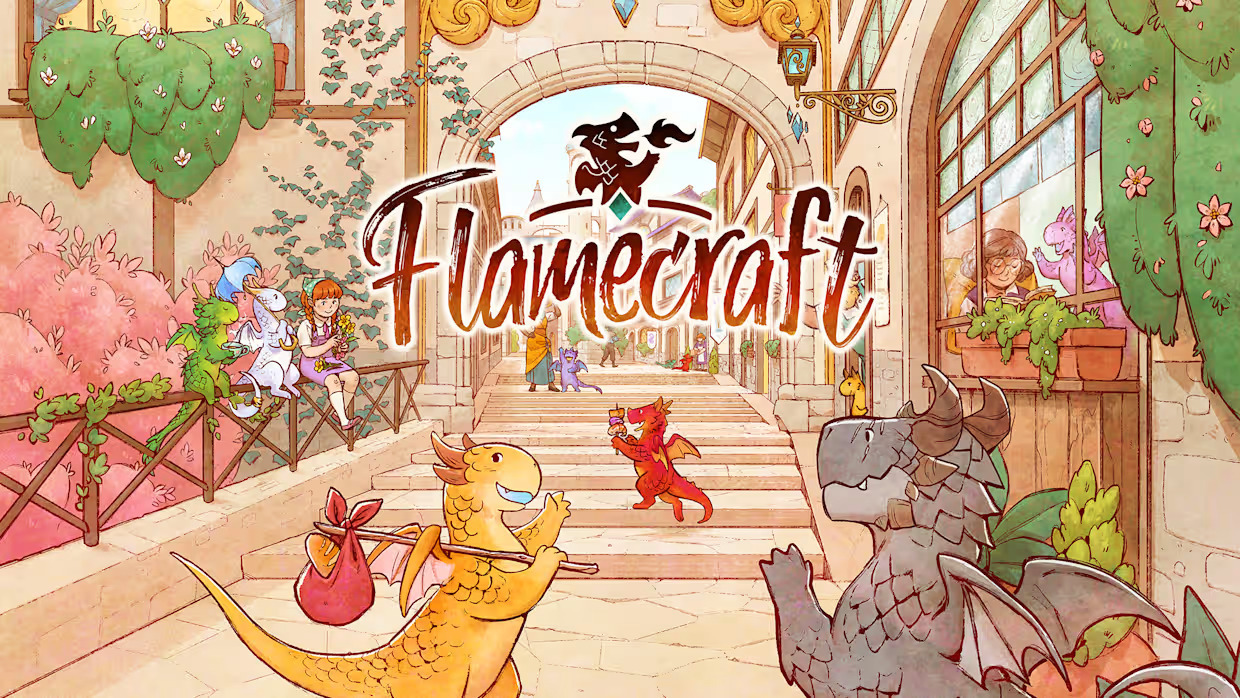
As is typically the case for digital board games, Flamecraft isn’t a narrative-driven game. The game instead relies on a simple but effective premise, meant to immerse players in its cosy dragon-inhabited fantasy world. Rather than hoarding gold or burning down thatched-roof cottages (bonus points if you understood that reference), Flamecraft’s dragons occupy themselves with actual jobs, like baking treats or running shops. As a so-called Flamekeeper, your job is to help these artisan dragons find their place in the town. The game does feature a solo campaign mode that expands upon the base premise, but the unlockable cinematics tied to this are more meant to up the game’s charm level and atmosphere rather than dramatically expand Flamecraft’s lore.
Graphics
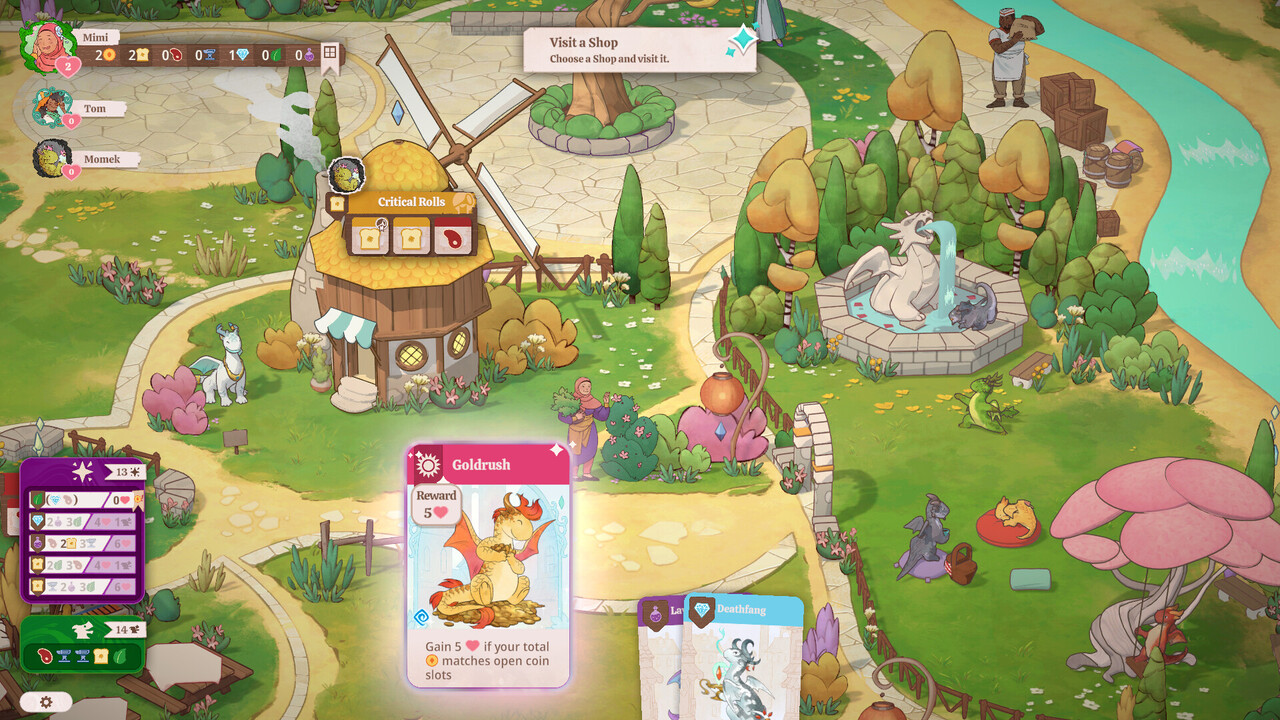
Aesthetically, Flamecraft remains faithful to the board game, though charming animations bring Sandara Tang’s illustrations to life in a new manner. The game features a colourful and vibrant 3D town populated by over 70 different dragons and 30 unique shops, complete with booths and laboratories that add character to the setting. The game’s UI retains a tactile feel, thanks to the use of cards and tokens that mimic those from the original board game. The adorable hand-drawn art style isn’t too taxing and Flamecraft runs like a charm, which is always good to see.
Sound
One thing that board games usually don’t have is a matching soundtrack. We’re happy to say that composer Paweł Górniak did an excellent job with his original music for the game. It’s pleasant and whimsical, and the perfect companion to the game’s cosy fantasy atmosphere. If you’re an owner of the physical board game, it’s well worth seeking this out and simply putting it on as you invite friends over for game night. That said, the music does do the heavy lifting here, as sound effects aren’t all that remarkable and voice acting is absent.
Gameplay
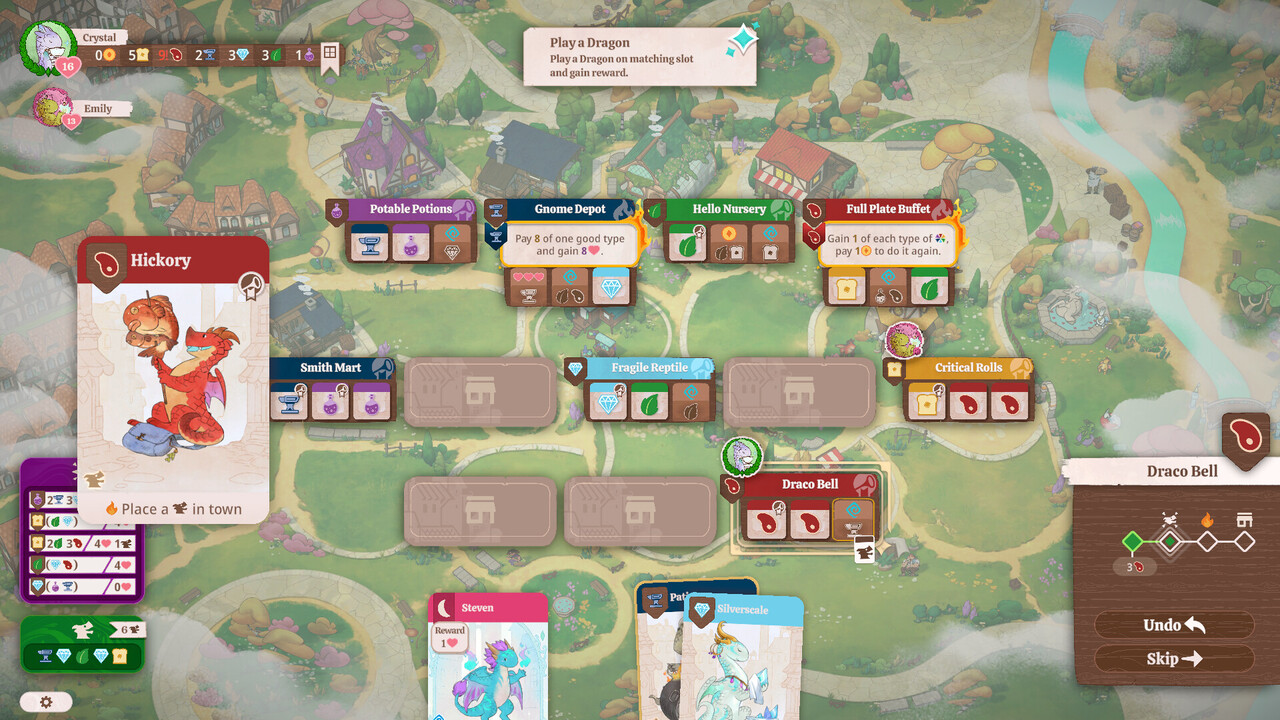
At its core, Flamecraft is a game that is all about resource management. You compete with other Flamekeepers to earn the most Reputation points before the game’s deck runs out. On your turn, you move a single dragon to a new shop each turn, paying a resource fee to any rivals already present, and choose between two core actions: Gathering or Enchanting. The former allows you to collect goods, place dragons into open shop slots to boost future yields and use special dragon abilities. Meanwhile, Enchanting requires spending your collected resources to cast spells onto shops, which permanently upgrades them and nets you large amounts of Reputation points in the process. As shops fill up with dragons, new and more lucrative shops open up on the board, creating a dynamic, expanding town. Beyond the core mechanics, there are also secret objective cards, known as Fancy Dragons, that provide an additional way of scoring points.
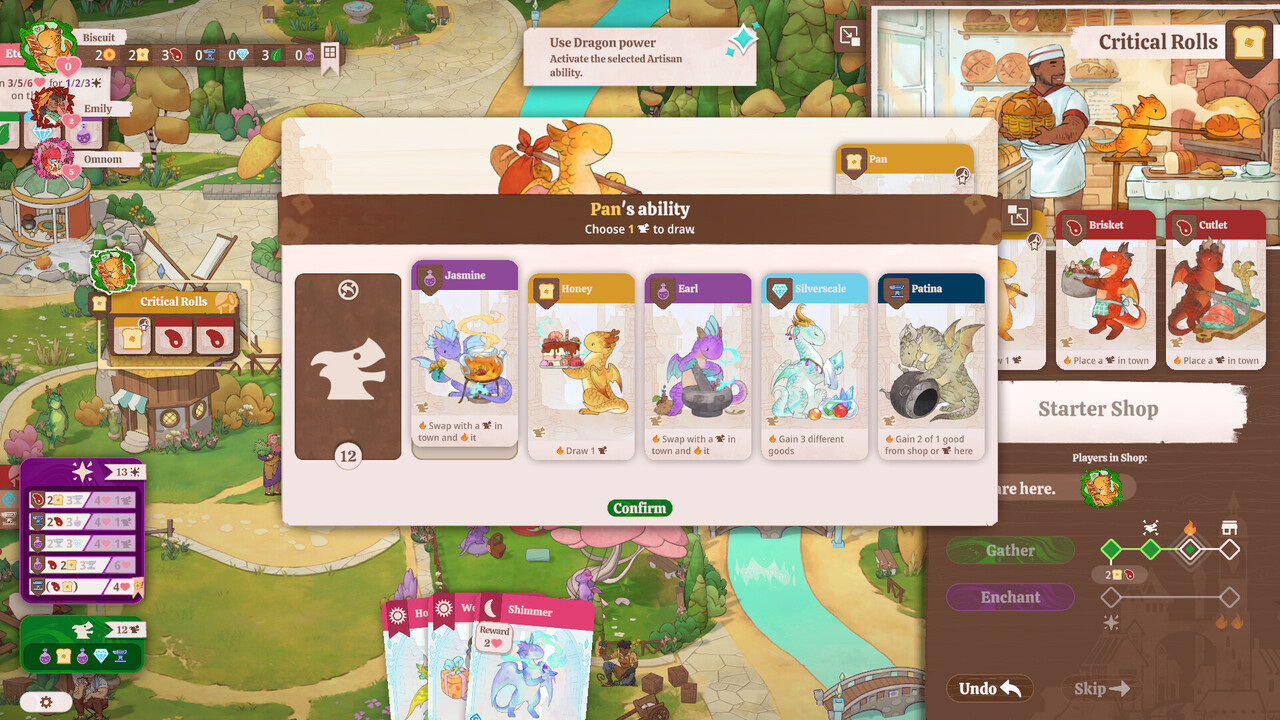
While Flamecraft is perhaps best enjoyed as a multiplayer game, where you compete against up to five other players locally or online, we spent the vast majority of our time with the game playing through the solo campaign. This was mostly because there weren’t a whole lot of people playing online pre-launch, of course. Fortunately, single player is very robust, with surprisingly clever computer-controlled opponents. You can adjust the difficulty level of those AI opponents, and there are two distinct enchantment decks to pick from. The Violet deck offers standard gameplay, and the Gold deck adds a harder mode aimed at more experienced players. Your typical game of Flamecraft takes about an hour to complete, though replay value is nigh-on infinite here, due to variable board setups, random order of drawn dragons and shops, multiple scoring paths and different difficulty tiers.
As with any board game adaptation, the main question is of course why you’d pick a digital version over a tactile, physical product that brings friends together around the living room table. In the case of Flamecraft, the single player campaign already provides a compelling argument, of course, but we also have to mention just how well the game flows when upkeep and city mechanics are handled automatically. Not only that, but the game’s interactive tutorial excels at explaining some of the more complex rules in an easy-to-understand step-by-step manner. Perhaps not as important, but nice to have, is that this adaptation of Flamecraft takes full advantage of the digital medium, allowing you to customise not just game setups, but also your profile with different colours, frames, avatars and dragons.
Conclusion
We wouldn’t go as far as to say that digital Flamecraft is the definitive version of the game, but it works well as a companion piece for anyone that loves the board game and wants a version that they can just pick up and play without a lengthy setup or when nobody is available to join them. And at €19.99, it costs less than half of the physical version. That said, if you don’t own a physical copy of Flamecraft, then this endearing adaptation may just convince you to buy the real-life game. Don’t say we didn’t warn you.

Related Items



1 Comment
Leave a Reply
You must be logged in to post a comment.
[…] playing (and enjoying) Flamecraft, giving Dragon Shelter a go seemed like a logical next step. On paper, it sounds like a great […]