


Developer: CROCFISH
Publisher: CROCFISH
Platform: PC, Android
Tested on: PC
FAIL GAMES – Review
We live in a time where developers continuously seem to strive for bigger, better, and more complex games. We’re not saying that is a bad thing, mind you. We absolutely love digging into the multitude of layers that Fire Emblem: Fortune’s Weave has to offer, and we were blown away by how vast Hunting Simulator 3 was, to name just a few titles. So when a developer decides to go against the grain, deliberately moving away from sprawling open worlds, elaborate control schemes and endless skill trees, we’ll admit that we’re at least a little intrigued. FAIL GAMES by indie developer CROCFISH is built around a ridiculous concept: a collection of frustratingly hard microgames, all controlled with a simple tap of your space bar and all over in seconds. Surely there’s more to FAIL GAMES than that, right?
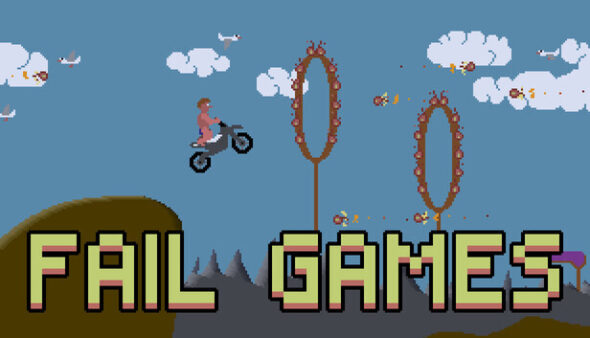
Beneath FAIL GAMES’ hyper-minimalist exterior, you’ll find an arcade experience that is addictive as it is straightforward. That same straightforwardness doesn’t just make the game stand out by sheer persistence, but it also makes it so that FAIL GAMES simply doesn’t fit with our usual review template. If we did that, then the story, graphics and sound sections would be ridiculously short. We could list all of the microgames, but since they all rely on a similar mechanical template, we’re much better off trying to explain what it’s like to play FAIL GAMES and what makes it so addictive. Even then, this is the kind of game that you really should play for yourself to really “get” it.
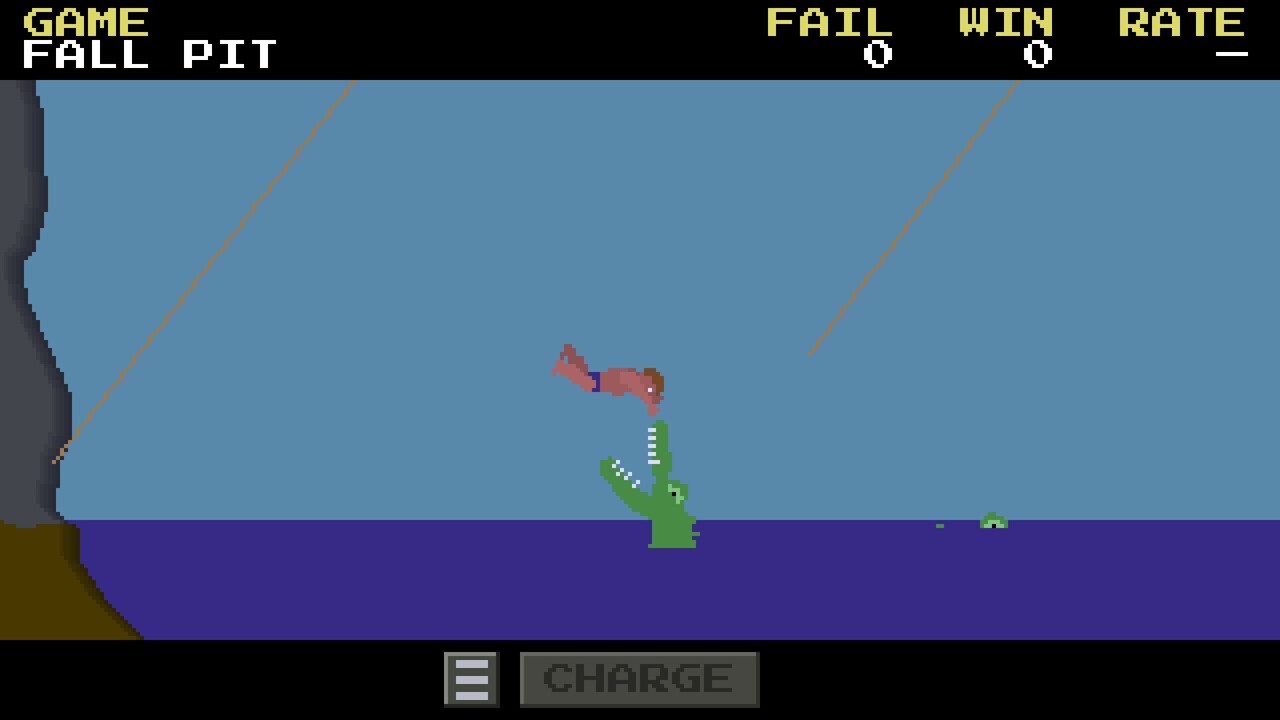
Channeling both the spirit and the aesthetics of 1980s microcomputer sports compilations, FAIL GAMES successfully captures a timeless and simple arcade philosophy: the aim of each game is understood in seconds, but the tiniest mistake carries immediate consequences. As the game’s title so clearly hints at, failure itself is at the core of the experience. The core loop is deceptively simple. You’re presented with an easy-to-grasp situation, usually sports-based: you could be put in the role of a cliff jumper, trying to land in the sea, or a stunt motorcyclist, trying to clear hoops. Whatever the task at hand is, all you need to do is hold down the space bar and release it at the exact right moment to launch your pixelated human towards the goal. Your fragile little character has only a single jump or propulsion phase though, meaning you must anticipate his trajectory with surgical accuracy.
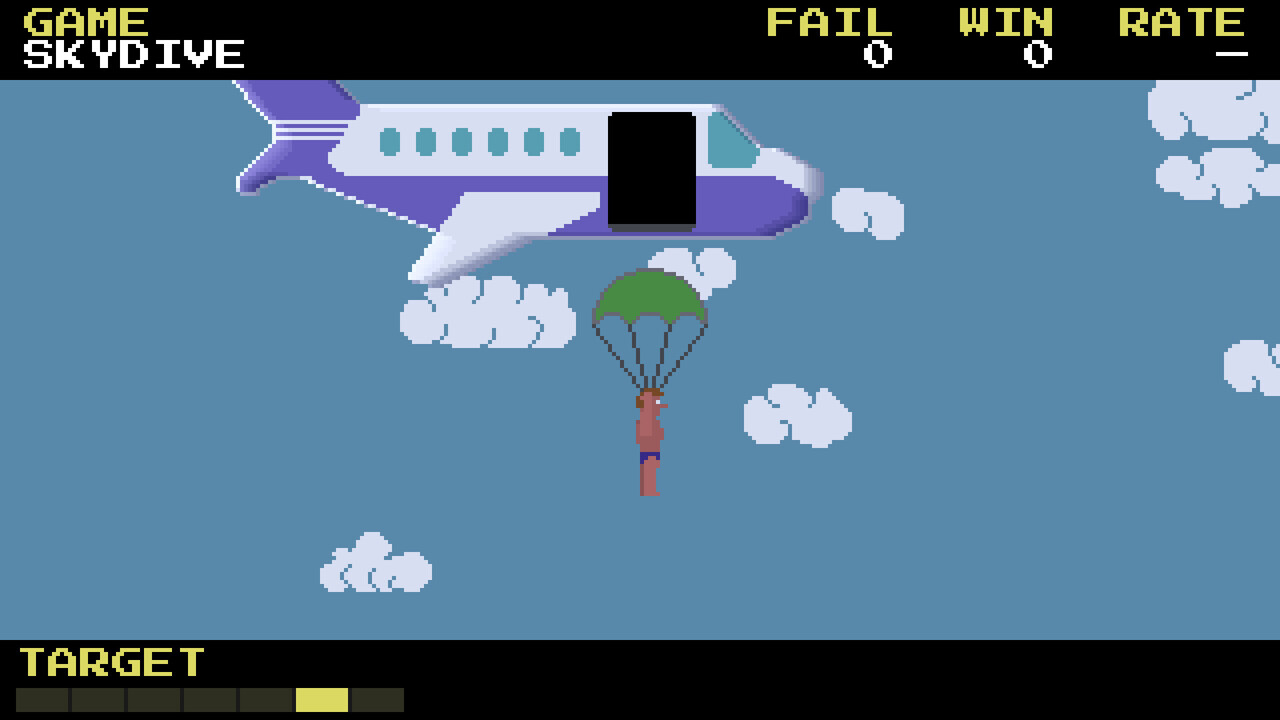
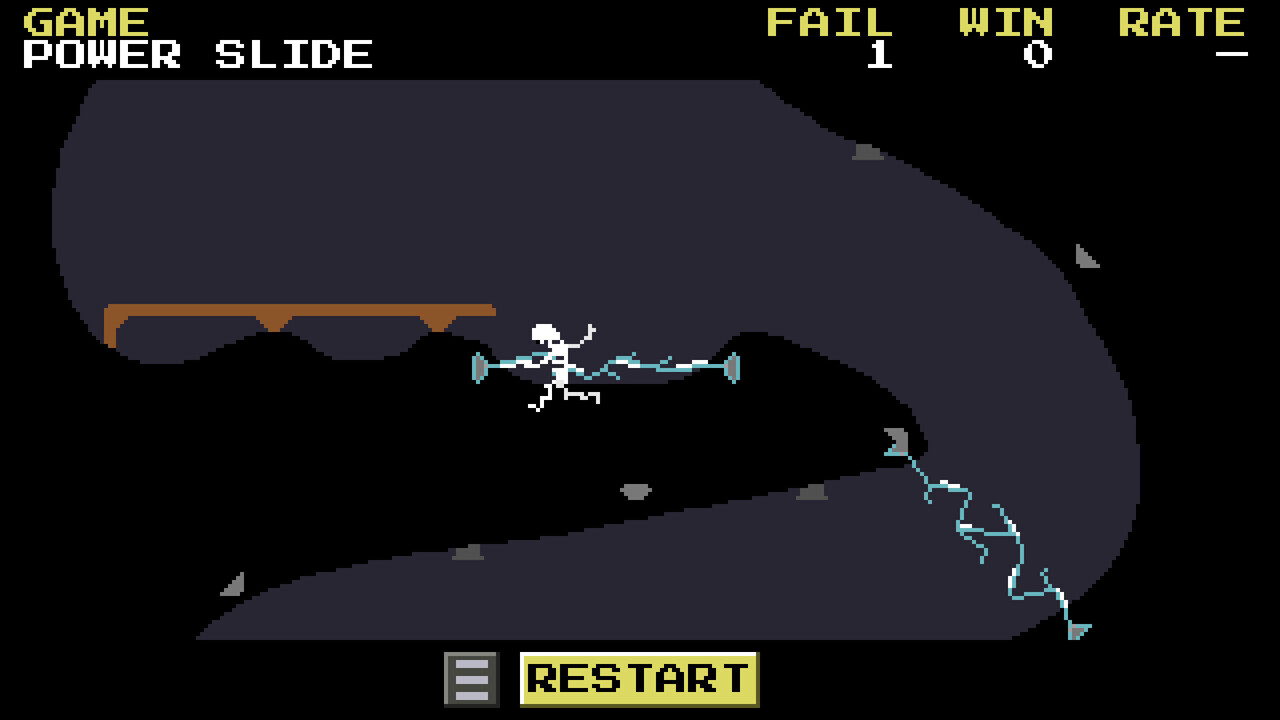
Of course, this is easier said than done. Stages are littered with hazards, including walls and even completely unpredictable seagulls (no, really) ready to obliterate your character at the slightest mistimed pixel. There is no margin of error. A fraction of a second too early or too late results in an instant game over. It’s brutally frustrating… but that’s actually where FAIL GAMES’ main strength lies. A stage lasts only a handful of seconds, and restarts are pretty much instantaneous. The moment you crash, you’re immediately thrust back into the action, ready for another attempt. And another. And another. The blazing speed with which failure is resolved creates an interesting mental loop. You start to see what went wrong and adjust your timing accordingly… only to fail again, in a different way. The game is as forgiving as it is punishing though, with the only reminder that you’re on your fiftieth attempt being the counter in the top corner of the screen.
As simple as the games are in theory, they’re surprisingly varied and the situations that your little guy gets himself into become increasingly absurd. Sliding down a ramp on skis before jumping? That seems normal enough. But when did you last see someone trying to make a backflip over a giant saw blade? Seeing whatever predicament the little guy finds himself into is always a fun surprise, and it prevents FAIL GAMES from becoming a repetitive affair. Another way that keeps FAIL GAMES from wearing out its welcome is an accessibility safety net: die thirty times in any given level (or any ten deaths thereafter), and you’re presented with the option to skip to the next level. It’s a smart compromise that preserves the punishing integrity of each challenge while ensuring you never hit a permanent wall.
As you clear stages, you earn in-game currency, which you can spend on cosmetics. You can dress up your little avatar, which is something he’ll probably appreciate given that he starts the game wearing nothing but a pair of speedos. Not only that, but there are also different filters, weather variations, and even slapstick gore options like dismemberment projections. Although these are all strictly cosmetic, they provide a wonderful extra layer of motivation. Beyond the solo campaign, FAIL GAMES also includes a competitive mode where you can team up with your friends or face off against computer-controlled opponents. Racing through a rapid-fire series of levels and watching a friend blow a lead at the final hurdle inevitably results in shouting as well as laughter. We’d argue that this competitive mode is where FAIL GAMES is at its best, especially if you’ve been using the solo campaign mode to practice your timing.
At the time of writing, FAIL GAMES hasn’t been released just yet, and pricing is yet to be confirmed. As such, we can’t say with certainty whether or not you’re getting bang for your buck here, though anything below €9.99 would seem like a good deal to us. Don’t be deceived by the game’s mechanical simplicity or retro appearance: once FAIL GAMES clicks, you’ll be hooked, as this is a game that is entirely built around that “one more try” feeling and the tiny dopamine hit that follows whenever you manage to clear another challenge.
Conclusion
Despite its title, FAIL GAMES is a success. The game prioritises crystal-clear readability over visual spectacle, and even then there’s fun to be found in the simplistic pixel art. What the game succeeds in wildly is turning frustration into pure motivation. Our initial expectations for the game were low, but the game proved that a single well-executed mechanic can deliver hours of addictive arcade joy. This is an unpretentious indie gem that will tempt you to keep giving it just one more try.





No Comments