


Developer: COLOPL
Publisher: COLOPL
Platform: Switch (2)
Tested on: Switch 2
Kazuma Kaneko’s Tsukuyomi
On the 22nd of April 2026, just under a year after it launched, the free-to-play title Tsukuyomi: The Divine Hunter was pulled from both Steam and mobile platforms. The very same day, a game with a suspiciously similar title, Kazuma Kaneko’s Tsukuyomi, made its appearance on the Nintendo eShop. We wouldn’t say that Tsukuyomi rose like a phoenix from the ashes as much as that the original release had become tainted. How, you ask? Read on, and we’ll explain it all, while also looking at whether or not this fresh start warrants giving Tsukuyomi a(nother) chance.

Story
The first few minutes of Tsukuyomi supposedly set up its central conflict, but unless you’re up to date on your Japanese terminology, you’ll probably end up not completely understanding what is going on here. The game opens with Ukiyo-e-style visuals that depict how the so-called Tsukuyomi (God-powered wizards) have been battling with Jinma (demons) for centuries. Fast-forward to Tokyo in the not-so-distant future, and one of the four remaining Tsukuyomi, Izayoi, is summoned to THE HASHIRA, a high-tech tower with a name that is consistently capitalized. Izayoi and his Kinshi (assistant), Takenouchi Mutsu, have to deal with a sudden mass outbreak of Jinma inside the tower. As the story unfolds, the other three Tsukuyomi become entangled in the Jinma situation as well. While we won’t go into spoiler territory too much, it’s worth noting that Kazuma Kaneko’s name being included in the title isn’t just referring to his behind-the-scenes involvement.
Graphics
It’s not often that the “graphics” part of the review takes up so much space, but then again, it’s also not often that a game’s visuals are so steeped in controversy as Tsukuyomi’s. The root of this controversy is Kazuma Kaneko himself. Nicknamed the “Demon Artist”, Kaneko is best known for his work as a monster designer for the early Shin Megami Tensei games, although you may also know him from Devil May Cry. With his name so prominently attached to the game, you’d expect him to be the lead artist here, right? Well, the truth is a bit different. While Kaneko’s artwork does form the basis, the monster designs in Tsukuyomi are entirely AI-generated. Supposedly, over two million of Kaneko’s drawings were fed to a generative AI to train a custom model that could mimic Kaneko’s art style, resulting in the card designs you see here.
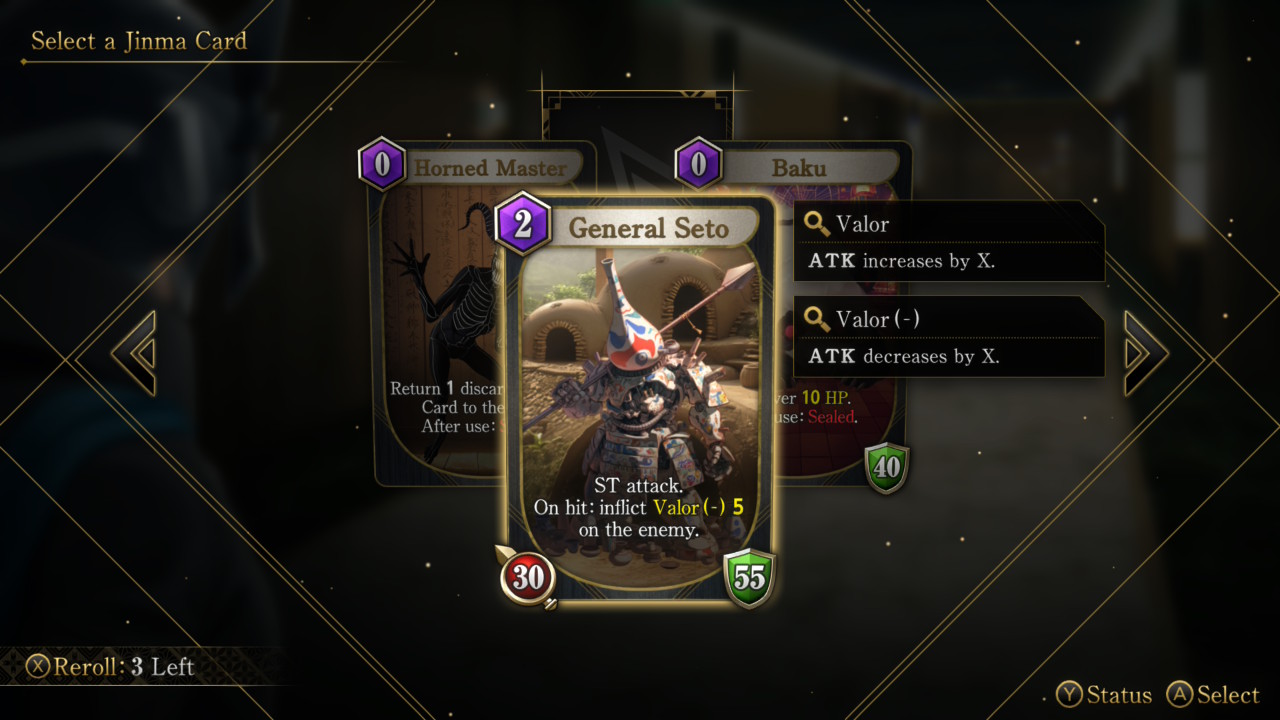
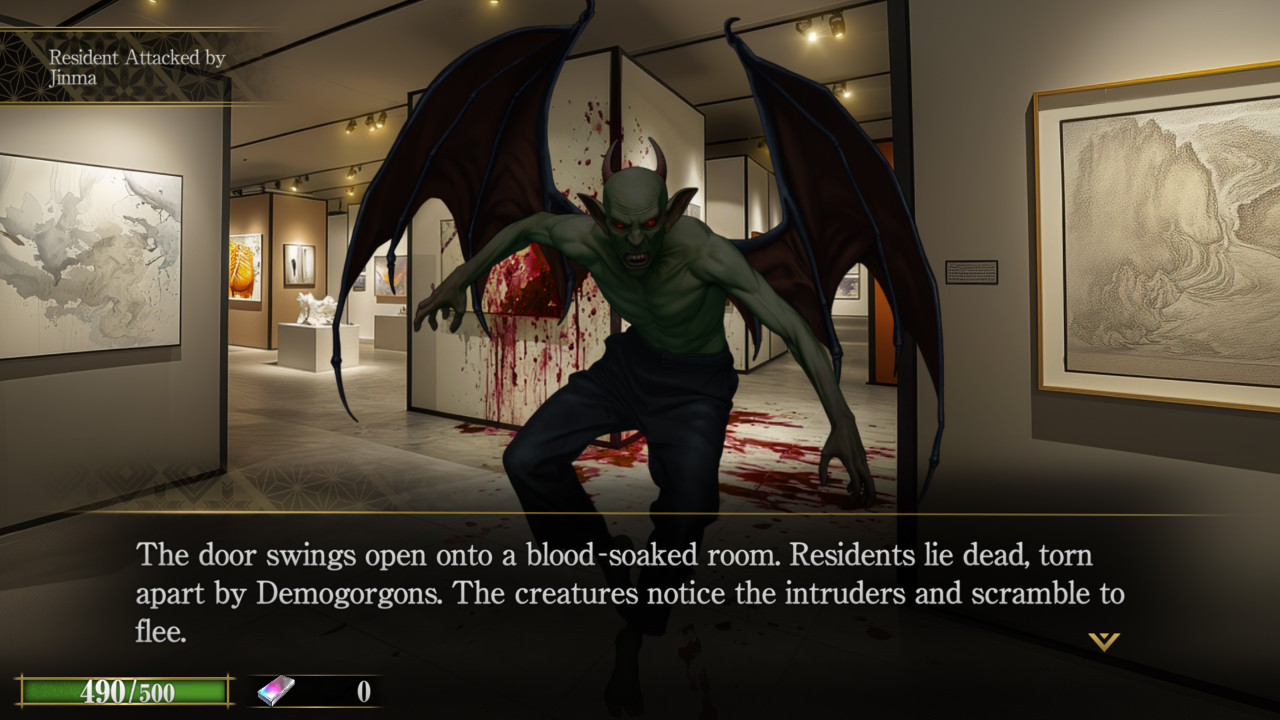
The original version of Tsukuyomi was a free-to-play title where players would generate custom cards on the fly. The problem here was that some of the randomly generated cards resembled copyrighted characters from both Disney and the DC universe, rather than just looking like Kaneko designs. The Switch version of Tsukuyomi does away with the in-game generative feature. While the card designs in-game are still the result of generative AI, Kaneko supposedly curated 3600 designs himself to be used here. Ironically enough, while the cards that made it into the game superficially resemble Kaneko’s art style, the monster designs never stand out and come across as generic. Because of Tsukuyomi’s dependence on AI visuals, the game is also lacking when it comes to animation. Apart from flashy card effects or navigating corridors, everything you see is a still image. Even non-card characters are typically limited to having only a single illustration, resulting in a game that feels uncannily static.
Sound
We’re not sure whether or not Tsukuyomi’s audio was also AI-generated, but given how generic most of it sounds, we wouldn’t be surprised. There is limited voice acting here in Japanese, particularly during the opening cutscene, but it doesn’t add a whole lot of depth. The music isn’t memorable, and the sound effects don’t add a lot either, making for a soundscape that simply doesn’t add a whole lot of substance to the overall experience.
Gameplay
We really don’t want to label Tsukuyomi as being a self-indulgent game, but the fact that there is far more to say about Kaneko’s appearance in the story and the controversy surrounding the visuals than about the gameplay doesn’t bode well. Tsukuyomi combines a roguelite deck-building system with visual novel-style storytelling. Taking control of one of the Tsukuyomi, you make your way through THE HASHIRA. Along the way, you’ll run into Jinma, whom you’ll have to battle, as well as random events that typically let you tinker with your deck of cards. At the end of each floor, a boss battle awaits you. Bosses are static, rather than randomised, and knowing what to expect, combined with a bit of luck, can make it so that your deck is particularly suited to taking down a specific opponent.
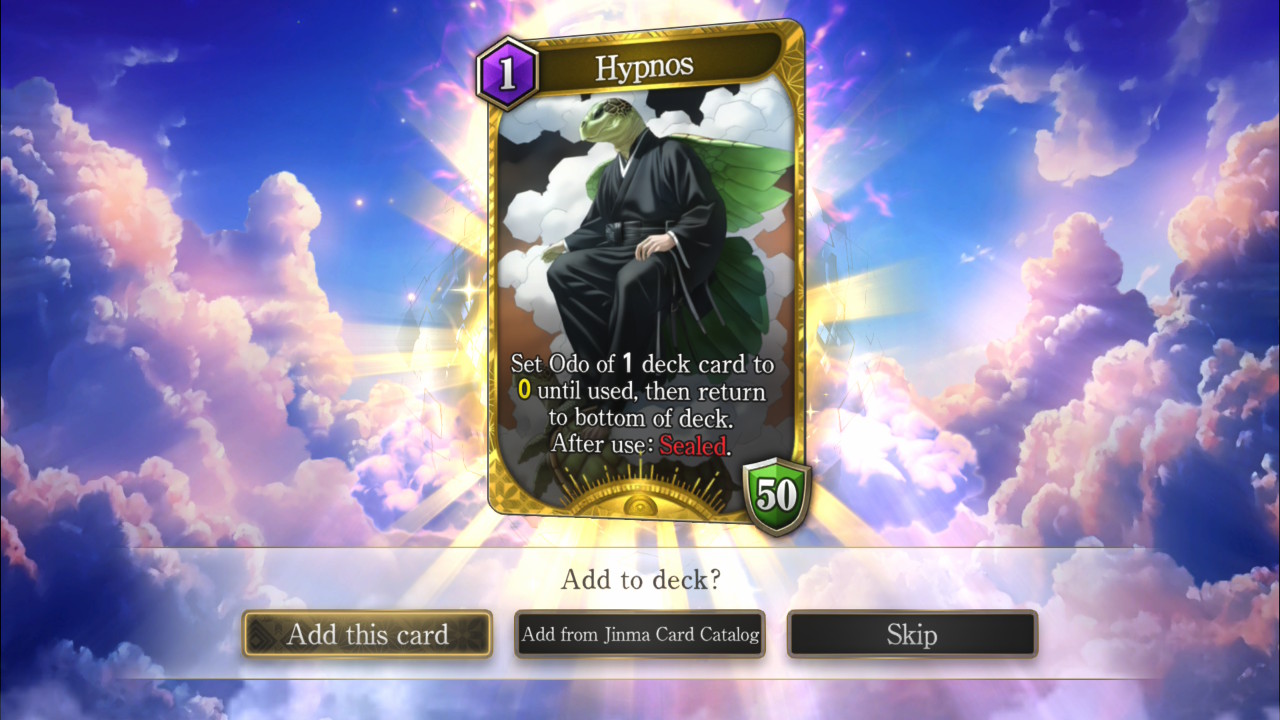
The basis of the card battle system is straightforward. You draw three cards at a time from your deck. Cards with an attack value will damage your opponent, cards with a defense value will absorb enemy attacks, and cards that have both can be used either way. Some cards provide buffs or other effects. Playing cards cost so-called Odo, with better cards typically being more expensive. Your goal is to knock out your opponent before they deplete your HP. It’s all fairly standard stuff for a deck-building game, with success coming from finding the right synergy between your cards. Each of Tsukuyomi’s playable characters offers a different playstyle, with Izayoi being good at tanking, for example, whereas Magetsu relies on status effects and the like.

There are a couple of mechanics with which Tsukuyomi tries to set itself apart from other entries in the genre. Taking a page from the Shin Megami Tensei series, for example, you’ll occasionally be able to force an enemy into a conversation and may even convince them to join you as a card. As you play the game, you’ll also garner the attention of the god Okami, who will grant you a powerful Creation Card. The traits of these cards are determined at the moment Okami gives you them, but they will persist throughout runs with the same character. The same can’t be said for standard cards that you upgrade throughout a run, unfortunately. The sense of progress for your starting deck comes from leveling up your character itself.
All in all, Tsukuyomi offers a not-too-deep card battler, with the core gameplay experience being overshadowed by unfair difficulty spikes. Yes, this is a roguelite, so a “bad run” is something that is to be expected, but the balance does feel all over the place here. This is something that is especially apparent in the post-game THE HASHIRA mode, which ramps up the difficulty even more. We’ve never played the free-to-play mobile version of Tsukuyomi, mind you, but it felt like the game was initially designed to squeeze money out of players’ pockets through microtransactions, and that the Switch port didn’t receive a rebalancing. If the gameplay genuinely stood out, this could be overlooked, but if you’ve got €24.99 to burn on a roguelite deck builder, there are way better options out there.
Conclusion
The Switch rerelease of Tsukuyomi is interesting in that it’s trying to keep alive a game that had become overshadowed by copyright issues and the ongoing debate about the ethics of AI-generated visuals. It’s little more than a curiosity though, and the only reason that it is a curiosity is the controversy surrounding it. Strip all that away, and you’re left with a painfully bland and generic deck builder. It’s functional, sure, but Tsukuyomi simply doesn’t bring anything substantial to the table. Go play Slay the Spire instead.





No Comments