


Developer: SMV Games
Publisher: EastAsiaSoft
Platform: PC, Switch (2), PS4, PS5, Xbox One, Xbox Series X|S
Tested on: Switch 2
The Fissure – Review
If you cast your mind back to the beginning of the year, you may remember our review of Winterlight. This visual novel stood out not because it was particularly well-written, but because it made use of AI-generated illustrations. SMV Games, the developer behind Winterlight, is now back with a follow-up novel, The Fissure. Given our lukewarm response to the previous one, the central question is whether or not they did better this time.

Story
As usual, we’ll refrain from telling you too much, as a visual novel’s entire point is to deliver a good story. Avoiding spoilers is doubly important for a narrative like that of The Fissure, as the central mystery is the driving force behind this psychological horror tale. What we can give away is The Fissure’s setup: our story begins with a young man, Nahuel, who travels to his mother’s old family home in the quiet and remote village of San Adraín. In Nahuel’s mind, San Adraín is uncharted territory, at least initially. Some things do feel familiar to him, but he attributes this feeling to stories that his mother used to tell him. San Adraín itself seems to disagree with the idea that Nahuel has never been there, however. Neighbours he’s never met act as if they’ve known him for years, townsfolk act suspiciously around him and, for some reason, everything smells like firewood. What follows is a story that sees Nahuel question both his memories and what is real about his own past.
We really can’t give away anything else. Not only in the interest of avoiding the story, but also because much of the narrative is shaped by the choices you make at key points in the story. Completely uncovering everything requires multiple readthroughs. The Fissure’s psychological horror angle resonated with us perhaps even more than Winterlight’s contemplative melancholy. That said, the writing itself falls victim to the same pitfalls as its predecessor. Once again, we were left feeling like at least part of the story was AI-written. Sentences are often overly verbose, coming across as hollow instead of deep.

Graphics
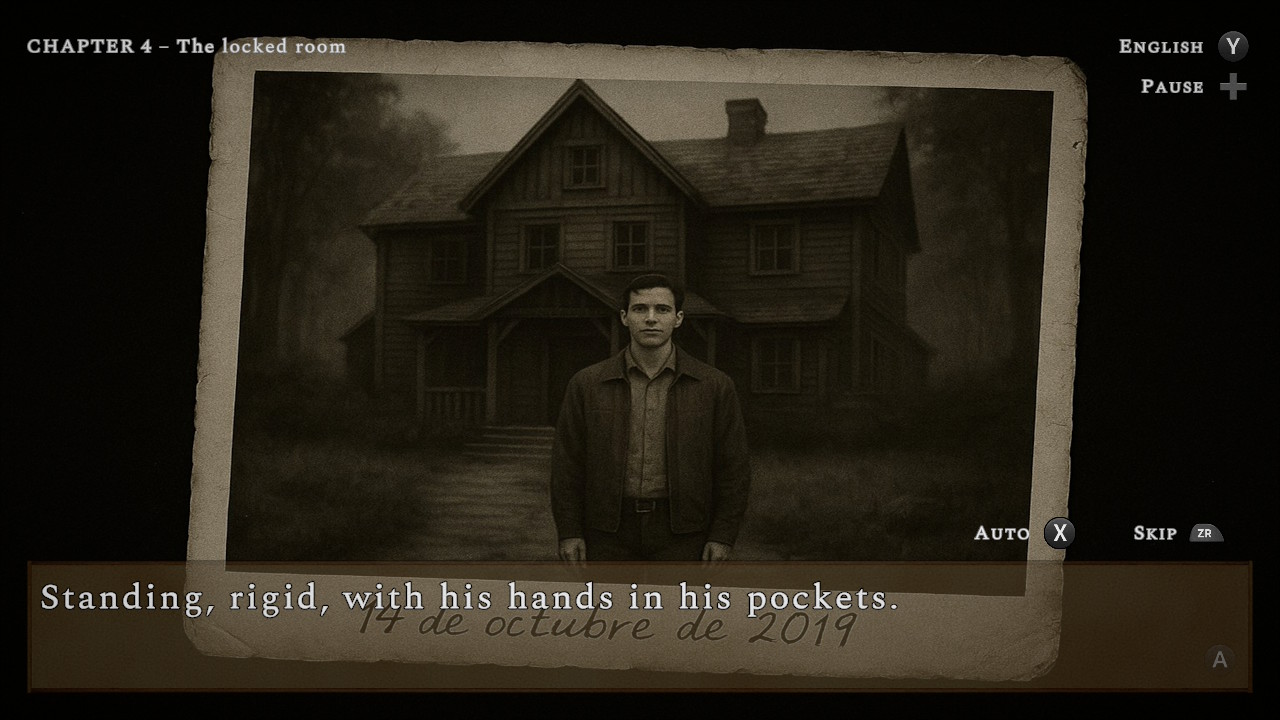
As we said in our Winterlight Review, we’ll keep the discussion about the ethics of generative AI out of the conversation. That said, we can still look at The Fissure’s aesthetics. Like with its predecessor, the illustrations in The Fissure were AI-generated. This time around, the developers opted for a more realistic style compared to Winterlight’s anime-inspired visuals. This wasn’t the right choice, as the illustrations suffer even more from a generic ‘slop’ look. You can instantly tell that there is something off, and the more you look at it, the more issues you start to see, like mistakes in perspective or nonsensical background text. You could argue that this uncanniness is fitting with the atmosphere that the story goes for, but more likely than not, this would be an unintentional side effect. The biggest issue, again, is that illustrations don’t line up with the text. A picture of a man is described as having his hands in his pockets, but they’re in plain sight. A wall clock doesn’t match the mentioned hour, and wouldn’t be able to sound the time, even though the story makes a point of both. These may seem like insignificant details on their own, but they do start to add up and break immersion.
Sound
As is usually the case with a visual novel, the soundscape is kept to a complete minimum. There is no voice acting present, and what few sound effects are present are functional but not particularly memorable. In fact, we believe these are identical to those used in Winterlight, at least when it comes to UI sounds. What’s left then is the so-called music, and this is just… awful. The opening chapters are accompanied by a droning track that wants to set up a mysterious and uncanny atmosphere, but that in practice sounds like the continuous humming of a car. Later on, the background music does alternate between this and more traditional orchestral music, but by that point, the damage had been done, and we preferred reading The Fissure with the sound of our Switch 2 turned off.
Gameplay
What can we say about The Fissure’s “gameplay” that we haven’t said in our Winterlight review? This is a standard visual novel, and it sticks to the same basic engine as SMV Games’ previous release. There have been a handful of UI changes: pressing the B-button now lets you re-read the previous line, and the skip function is now behind a shoulder button, so you won’t need to go into a pause menu to use it. Accessing the text log is still a little fiddly, requiring you to navigate multiple menus, but overall, this is a slight improvement compared to Winterlight.
There’s also a CG gallery, with illustrations that are automatically unlocked when you encounter them in the story. Unlocking all of them requires multiple readthroughs, where you make different choices. Of course, if you want to get to the bottom of The Fissure’s central mystery, this is something you’d need to do anyway, and we found ourselves referring to the gallery not as the game intended but as a checklist to see if we’d missed anything. Once the entire gallery was unlocked, we considered The Fissure ‘beaten’. This took us around 8 hours, though we’ll admit we did use the skip function on subsequent readthroughs for any text we’d already sat through. We’d say that that is a fair amount of time for the novel’s €4.99 RRP, even if The Fissure’s overall level of quality is uneven.

Conclusion
As much as we enjoyed figuring out the overarching mystery behind The Fissure, we couldn’t help but be somewhat underwhelmed by the overall execution. Even without getting into ethics, the novel’s reliance on AI-generated visuals comes across as lazy. Illustrations don’t line up with text, said text is wonky in places and the soundscape is uninspired at best. Winterlight made those exact same mistakes, leading us to conclude that the developers simply didn’t care enough to do better. And if they don’t, why should you?

Related Items




1 Comment
Leave a Reply
You must be logged in to post a comment.
[…] as EastAsiaSoft is concerned. Over the last couple of months, the publisher has mostly focused on visual novels with AI-generated illustrations and cheap, bite-sized puzzle games. It has been a while since we last saw a meatier game appear in […]