


Wardrum – Review
What if you combined Patapon with Darkest Dungeon? It’s a question we never asked ourselves, but it is one that Mopeful Games set out to answer with their latest game, Wardrum. Mixing turn-based strategy with rhythm gameplay may be an unconventional idea, but it could just be crazy enough to work. Can this combo drum up enthusiasm, or does it fail to hit the right beat?

Story
In the world of Wardrum, rhythm is fundamental to the natural order. It is tied to the Rhythm Mother herself, a goddess worshipped by a tribe of so-called Wardrummers. When a mysterious force starts to destabilize the world by means of off-beat magic, the leader of the Wardrummers, Yelder Strongwrist, rallies his fellow tribesmen to fight against this corruption. Rather than focusing heavily on deep character backstories or narrative twists, Wardrum emphasizes the tribe’s journey through increasingly dangerous biomes and the idea of unity, rhythm, and survival as the world continues to deteriorate under the magical threat.
Graphics
Combining pixel art character models with 3D environments, Wardrum’s visuals bring to mind Square Enix’s HD-2D art style. The game’s art direction heavily leans into dark fantasy aesthetics, with a wide variety of environments ranging from forests and swamps to deserts and mountains, and even crypts and nighttime battlefields. Environmental details, such as rocks, traps, bushes, spike nests, barrels, and volatile terrain, contribute to both the visual variety and gameplay mechanics. Likewise, the different character sprites and enemy designs add to the game’s overall feeling of visual variety. Special mention should be given to the game’s dynamic camera. During combat, the game zooms in and shifts angles, adding a dramatic flair to the battles. Another highlight here is just how readable everything is, even in the heat of battle. Movement and attack ranges are clearly highlighted, which is a huge boon when it comes to managing positions during tactical encounters. Performance doesn’t stand in the way of Wardrum’s visual clarity either: the game isn’t overly demanding, and there were no notable issues that we ran into.

Sound
With how integral rhythm is to both Wardrum’s plot and its gameplay, it’s not surprising that the game’s soundtrack takes center stage. The music is heavily centered around percussion and rhythm, acting both as musical accompaniment and gameplay guidance, as you must time your attacks and abilities to the beat. The rhythm mechanics are fantastically integrated into Wardrum’s sound design, with timing cues, musical changes, and percussion helping you stay in the flow of combat. Sound effects complement this without overpowering things: attacks, weapon strikes, and magical effects provide strong audio feedback. Ambient effects like rain and other environmental effects add atmosphere without interfering with that all-important gameplay clarity.
Gameplay
Combining turn-based tactical combat with rhythm game mechanics, Wardrum brings a unique take on two familiar genres to the table. Adopting a roguelite progression structure, the game’s core loop sees you guide your warband through a branching world map filled with battles, treasure, and random events. Along the way, you’ll gradually unlock upgrades and new characters. Wardrum has a plethora of different fighter classes available, including melee, archers, spearmen, support drummers, and spellcasters. As these level up, they can be customized with new abilities, passive upgrades, branching development choices, trinkets, artifacts, and even custom-crafted abilities created through a forging system using collected rhythm stones. True to Wardrum’s roguelite structure, between runs you return to hub areas where you can revive allies, unlock permanent upgrades, improve future runs, and recruit additional playable characters.
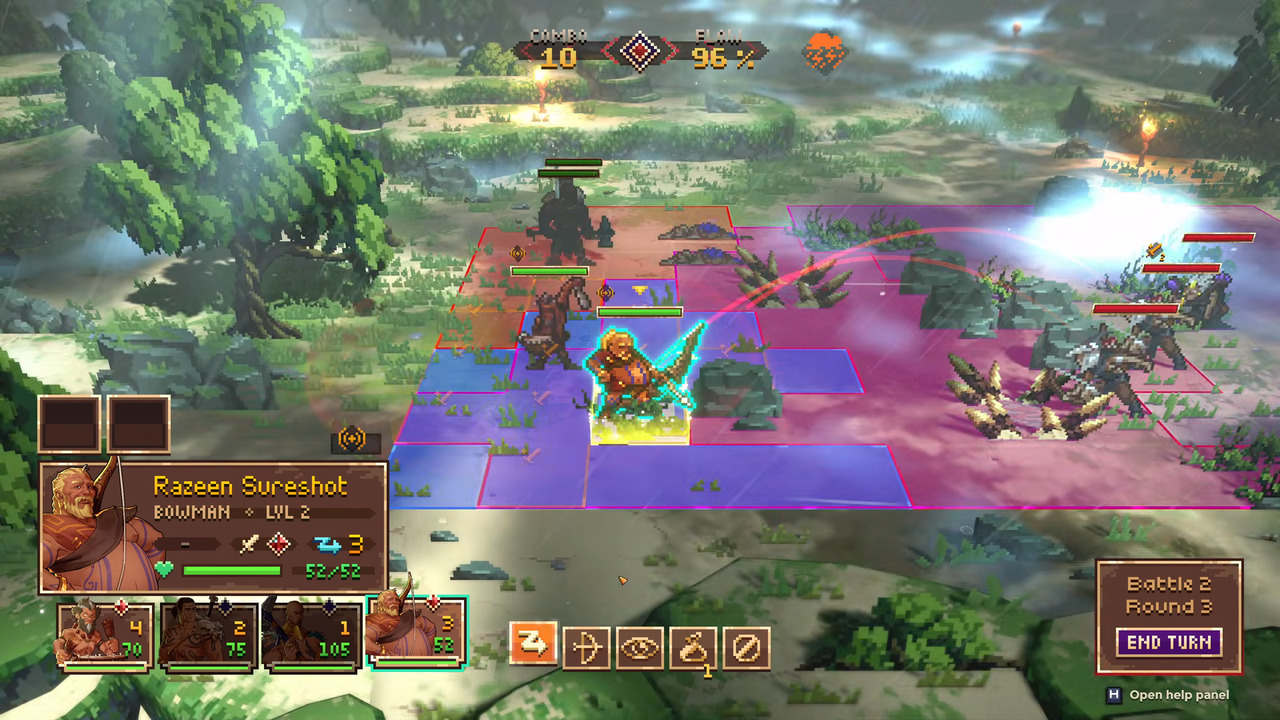
Combat takes place on grid-based battlefields and centers around the game’s unique rhythm-based input system. Your attacks, spells and abilities require timed button inputs synchronized to the game’s drumbeat. Each action uses its own rhythm pattern. Some are as simple as single taps, while others require holding notes, simultaneous presses, double taps, or more complicated sequences. The accuracy of your inputs has an effect on your damage output, and can increase your critical hit ratio, strengthen your abilities, or reduce penalties. Conversely, poor timing weakens your actions. There is more to Wardrum’s combat than just having a good sense of rhythm though. Positioning and team composition are almost as important. Taking advantage of your environment can often make the difference between failure and success as you can push enemies off cliffs or use traps and other environmental hazards. The synergy between rhythm execution and tactical decision management is where Wardrum’s gameplay really comes together.
That said, Wardrum’s gameplay does come with a cost: this is a very demanding game. Battles can feel overly long, with large enemy groups and repeated rhythm sequences that start to wear you down over time. In our reviews, we occasionally point at a game and tell you it’s best enjoyed in short bursts rather than prolonged sessions. This definitely applies here, because playing Wardrum over a longer time simply becomes exhausting… and not in the Just Dance or Fitness Boxing kind of way. Once you factor in the game’s difficulty, you’ll quickly find that you’re replaying the same battles over and over again, with some encounters feeling outright unfair due to enemy numbers, debuffs, or sudden difficulty spikes. Status effects can also interfere directly with rhythm gameplay by altering inputs or obscuring timing cues. We can’t quite tell you how much game time you’re getting for your €19.99, because we didn’t reach the credits yet for this very reason. How well that translates to bang for your buck depends heavily on your tolerance for repetition and difficulty. We do feel that the overall experience could have been significantly shorter without losing much.

Conclusion
This one isn’t for the faint of heart. As good as Wardrum’s core gameplay is, the game definitely overstays its welcome. This is the kind of title where we’d be happier if the dev team had “trimmed the fat”, so to speak, and offered a smaller, more focused experience. Don’t get us wrong, Wardrum is an excellent game, but with it being so tiring to play, we can only wholeheartedly recommend it to people looking for an intense challenge.





No Comments