


Developer: Relic Entertainment
Publisher: Relic Entertainment, Games Workshop
Platforms: PC
Tested on: PC
Warhammer 40.000: Dawn of War – Definitive Edition – Review
Back in the early 2000s, Games Workshop’s Warhammer 40.000 tabletop miniatures game was definitely on our radar, though we never actually played it. Our focus was — and still is — on The Lord of the Rings Strategy Battle Game, another Games Workshop game. Coincidentally, both WH40K and The Lord of the Rings got RTS adaptations around that time. Moving in WH40K-adjacent circles, we struck up friends and ended up alternating between their copy of Dawn of War and ours of The Battle for Middle-Earth in multiplayer games. We don’t recall a whole lot about Dawn of War’s gameplay, except that we couldn’t win a single game. The release of Dawn of War – Definitive Edition gave us a chance to rectify that and relive a time we fondly remember, regardless of our humiliating defeat. The question at hand is whether the game stands up to modern scrutiny if we remove our nostalgia goggles?
Story
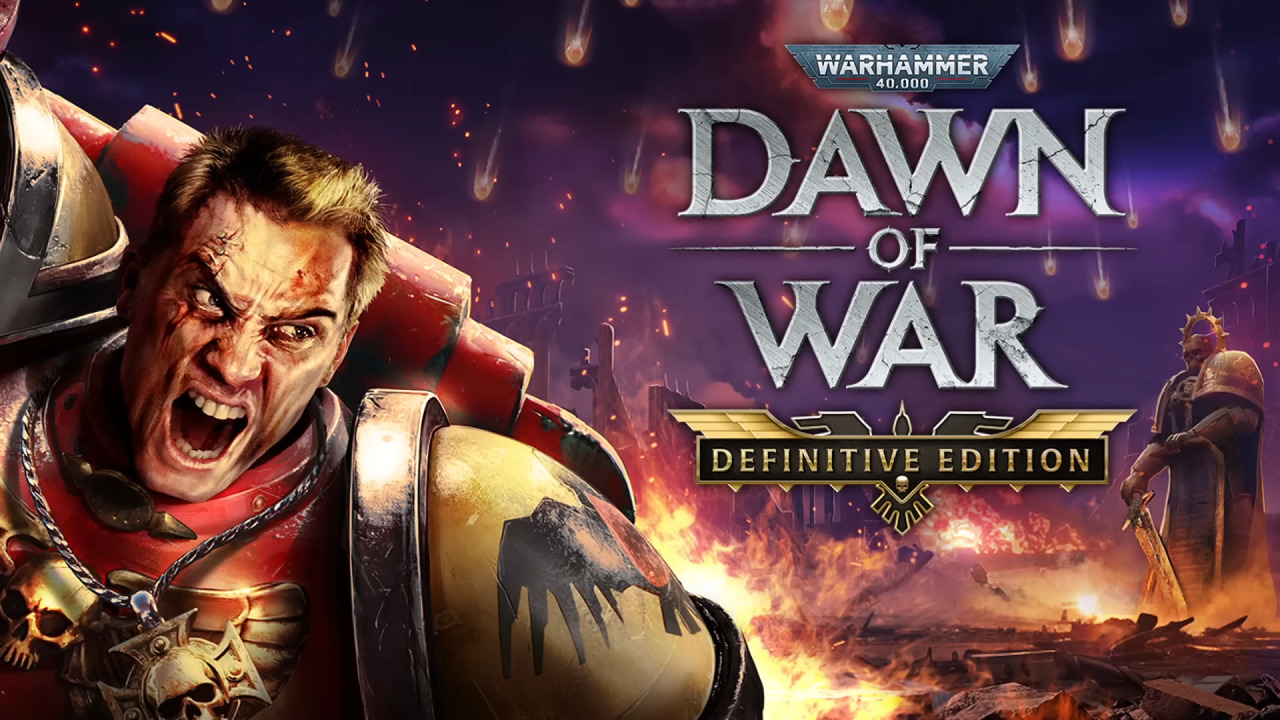
“In the grim darkness of the far future, there is only war.” With this tagline, WH40K both sets its tone and summarizes its setting. Across the base game and three expansions, Dawn of War delivers just as many classic WH40K stories, each with its own narrative and playable factions. The titular Dawn of War campaign follows the Space Marine chapter of the Blood Ravens, as they battle an alliance of Orks and Chaos Space Marines across the planet Tartarus. Winter Assault once again pits Space Marines against Orks and Chaos, although the former are joined by Imperial Guard this time around, as the two sides clash over an ancient artifact. Dark Crusade and Soulstorm let players pick their faction instead, each with their own campaigns, cutscenes, and victory conditions, with the former offering a non-linear conquest mode on the planet Kronus and the latter expanding the concept to a multi-world conflict. Regardless of which campaign you decide to get stuck in, they all encapsulate WH40K’s signature gothic sci-fi lore. By modern-day standards, the writing is over-the-top and almost comes across as a satirical parody of itself, in the best way possible.
Graphics
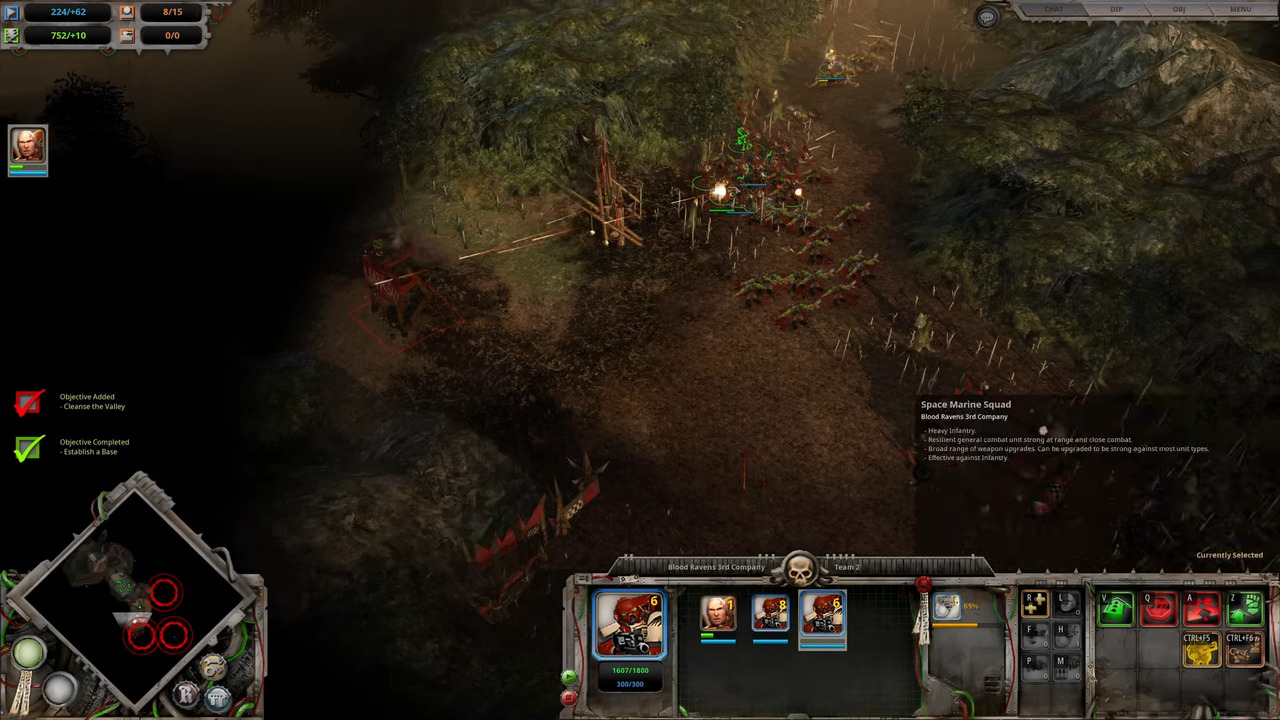
Sticking closely to both the grimdark WH40K aesthetic and the look of the original version of the game from 20 years ago, Dawn of War – Definitive Edition looks pleasingly retro. While the visuals have undergone some major rehauls, the results are subtle and preserve the feel of an early 2000s RTS game. The game does benefit from a bump in resolution as well as improved lighting and shadows, but the character models have remained blocky and stylized. This incarnation of the WH40K universe may not be up there with modern titles like Space Marine II, but it doesn’t want to be: This is Dawn of War, warts and all. The hardware that you’d run the game on is much more powerful than 20 years ago, and the game runs flawlessly on modern systems.
Sound
Much of Dawn of War’s old-school charm is derived from cheesy, over-the-top voice lines that you’ll hear repeatedly as you guide your units around the battlefields of the 41st Millennium. Quotes like “For the Emperor!” or “Walk softly, and carry a big gun.” may have lost their gravitas over time, but they’ll still put a smile on the face of anyone who lived through the original releases of the game. In cutscenes, dialogue still doesn’t match mouth movements, which, on one hand, ruins the immersion, but on the other hand, makes things feel more authentic. The game’s soundtrack isn’t as memorable as the voice work, but its combination of orchestral and industrial tones is very fitting for the WH40K setting. As for the sound effects, allow us to use an in-universe term and confirm that Dawn of War’s soundscape has plenty of ‘Dakka’ to offer.
Gameplay
Harkening back to a different era of RTS games, the Definitive Edition of Dawn of War offers a faithful restoration of the classic 2004 game. A handful of QoL tweaks provide the game with some more breathing room on modern hardware, but by and large, this is the exact same game from 20 years ago. For those of you who haven’t played Dawn of War, that translates to a fast-paced, base-oriented, and gloriously chaotic old-school RTS. The gameplay sticks close to the template of that era, revolving around the construction and management of your own base, where you train units and upgrade your technology. As you build structures, you unlock different unit tiers, and there is a constant sense of an arms race with the opposing faction, with your aim in most scenarios being to wipe the enemy base off the map. Resource management is built around Requisition, which you earn by holding strategic points on the map, and Power, which requires the construction of generators in your base.

Combat is at the heart of Dawn of War -it is a WH40K game after all- but it does not require deep strategic insight. Instead, you simply send out squads of units to try and overwhelm your opponent. Squads can be reinforced mid-battle, and you can attach iconic hero units like commanders and psykers to them for buffs. Once the lines meet, you’re treated to large, kinetic clashes full of explosions, morale breaks, and screaming troops. What Dawn of War lacks in depth and sophistication, it more than makes up for in big dumb fun. If you want to see squads of Space Marines duke it out against hordes of Orks without having to spend a ton of cash and dozens of hours painstakingly assembling and painting miniatures, this may just be your best option. The QoL tweaks that were introduced in the Definitive Edition include a clearer UI and a modernized HUD. While these are welcome additions, there are some quirks present in the game that should have been the focus instead. Unit pathfinding isn’t up to snuff, with units getting stuck behind buildings, and there are instances where unit AI doesn’t respond to combat, instead standing idly. While we appreciate the dedication to authenticity, these kinds of things weren’t in the original by design in the first place, and so they should’ve been dealt with.
With four campaigns and nine playable races, each one offering its own unique playstyle, Dawn of War has a wealth of content to offer before you even get to the game’s skirmish and multiplayer modes. The individual campaigns are fairly short, but they add up to roughly 40 hours of single-player content, with a ton of replay value if you factor in the different factions. At an RRP of €29.99, that’s a great deal for fans of old-school RTS fans, but if you happen to have the original Dawn of War sitting in your Steam Library, then you can get this rerelease even cheaper. Dawn of War isn’t a game for a mainstream audience, but if you happen to be in the niche that this release targets, you’re going to be hard-pressed to find a more attractive proposition this year.

Conclusion
Let’s not kid ourselves: nostalgia played a huge factor in how we perceived Dawn of War – Definitive Edition. That’s not a bad thing per se, as nostalgia is inherently part of the appeal of this collection. If, like us, you grew up with games like this, then playing this faithful recreation is a delight. For newcomers, Dawn of War is a time capsule, a glimpse into RTS history. It’s the kind of game that admittedly lacks wide appeal, but if you can appreciate its clunkiness and shortcomings, then you’ll have a great time (re)playing Dawn of War.



No Comments