


Developer: Nintendo, TNX
Publisher: Nintendo
Platform: Switch (2)
Tested on: Switch 2
Rhythm Paradise Groove – Review
Leave it to Nintendo to say goodbye to the original Switch in the most Nintendo way possible. Rhythm Paradise Groove (or Rhythm Heaven Groove for those of you on the other side of the ocean) is likely the last Switch 1 game published by the Big N themselves. That doesn’t mean that the little hybrid device is now dead, because there are definitely still third-party releases in the pipeline, but the writing is on the wall. Is there rhythm to the console’s swan song, or does it miss the final beat?
Story
There is no overarching story in Rhythm Paradise Groove’s main mode. Instead, the game features bite-sized, self-contained mini-narratives and contextual premises for its plethora of mini-games. One minute you’re playing as a dog, counting down to grab a frisbee, and the next, you’re trying to sneak past a moon suffering from a sneezing bout. The closest the game comes to fleshing out one of its premises is in Beatspell, an RPG-like mode where you set out to battle elemental monsters and save a prince through rhythmic spell-casting. The vast majority of the game intentionally operates outside of narrative conventions, relying purely on surrealism. In this regard, Rhythm Paradise Groove actually reminded us of the WarioWare series, which adopts a similar approach for its microgames.
Graphics
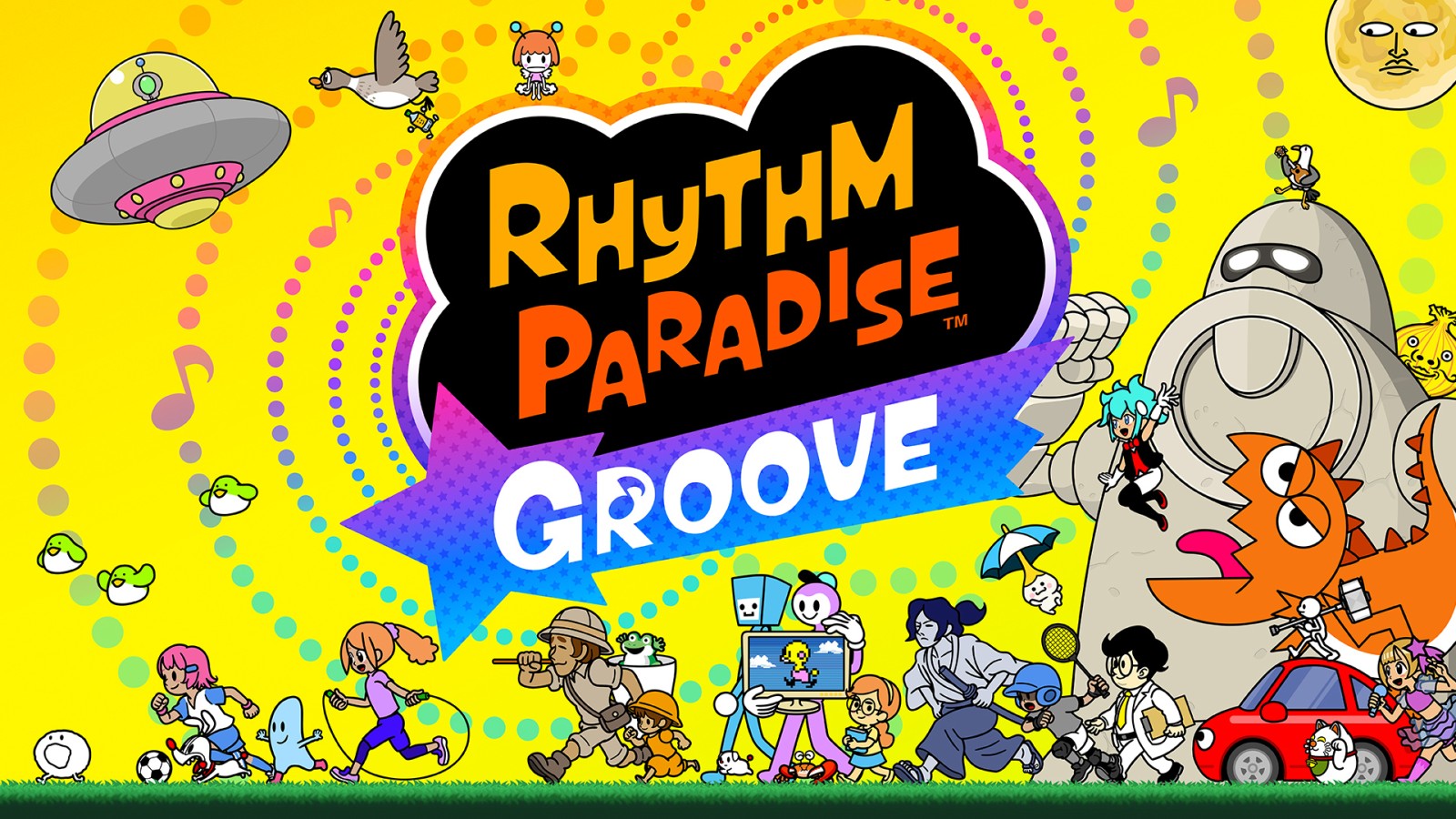
In fact, that WarioWare vibe is present in the game’s visuals as well. Rhythm Paradise Groove features a bold, bright, thick-outlined 2D art style that mixes crude simplicity with cartoon-style animation and occasional hyper-realism. While the game’s eclectic cast of robots, ninjas, and the like doesn’t have fleshed-out personalities in the traditional sense, they do have plenty of character. The devil truly is in the details, with other characters subtly reacting to you if you miss a beat. The game relies on deliberate on-screen chaos to distract you. It’s a good thing then that the game’s relatively simple art style isn’t demanding. Frame rate remains consistently smooth, and any time your concentration breaks can probably be attributed to an intentional attempt from the game itself.

Sound
Audio is essential to the gameplay loop of any rhythm game, of course. We’re happy to say that Rhythm Paradise Groove delivers here, both in terms of precise gameplay feedback and when it comes to the music itself. The game’s soundtrack features a broad and energetic selection of high-quality original compositions, ranging from metal to electronic beats and even J-Pop. Sound effects are just as varied, with every mini-game having unique in-theme audio-cues, like the annoyed coughs of fellow umbrella dancers when you don’t nail your timing. The game also utilizes a text-to-speech narrator, similar to the voices in Tomodachi Life, which reads out gameplay prompts and player names in multiplayer. This robot voice only adds to the overall surreal atmosphere of the game.
Gameplay
Rhythm games are typically straightforward affairs. You’re first introduced to a set of basic mechanics, such as hitting buttons in time with icons moving across a grid. As you progress through the game, things become more involved and challenging, but the core mechanics remain the same throughout. Rhythm Paradise Groove, however, is not a typical rhythm game. Instead, you’re getting a series of self-contained mini-games, each with its own rules and mechanics. Not a single one of those games is just handed to you either. You’ll need to unlock each and every one of them across the game’s progression grid. Each column of four distinct mini-games culminates in a fifth Remix stage that blends all four previous games together into a single cohesive medley set to its own full song.

Each game opens with a (skippable) tutorial, easing you into what you’re supposed to do. Individual mechanics are often deceptively simple, and the trick to mastering Rhythm Paradise Groove is in getting your timing exactly right, rather than memorizing button sequences. In fact, most mini-games in the game’s main campaign rely solely on the A button, although there are some that incorporate D-pad directions for secondary inputs. You’ll need to get a ‘Good’ rank or better to progress to the next game, with ‘Amazing’ ranks netting you medals that can be spent on soundboards, rhythm quizzes, a step sequencer, drum lessons and a jukebox. One major downside is that if you happen to run into a game that is particularly tricky, it may feel like hitting a wall. A way to skip a game and return to it later would have been welcome. Outside of the main mode, the aforementioned Beatspell mode breaks the mold somewhat, as you’re required to input rhythmic button patterns instead of those single-button controls in order to cast spells, manage buffs, and deplete enemy health bars.
Most of our time with Rhythm Paradise Groove was spent in single-player mode, but the game is an excellent party game as well, allowing you to team up with up to three other players. When you combine solo and multiplayer modes, you’re looking at over 100 mini-games, adding up to a very generous package, especially for the game’s €39.99 price of entry. That said, it’s worth noting here that there was a noticeable difference between handheld mode and playing docked, which is the go-to when playing with others. The timing felt ever so slightly off when playing docked, even compared to tabletop mode. Hopefully, this is addressed in a future patch, because although it isn’t game-breaking, it can make the difference between a ‘Good’ and ‘Amazing’ rank. Don’t let this deter you from giving Rhythm Paradise Groove a try, though. As far as rhythm games go, it feels less about score chasing and more about having fun. In fact, you’re never given an outright points score. This one is all about those ranks instead. We told you it wasn’t a typical rhythm game.

Conclusion
Perhaps the best way to describe Rhythm Paradise Groove is that it’s a rhythm game that even players who don’t normally enjoy the genre can appreciate. The wide mechanical variety of mini-games, combined with their outright zaniness, will appeal more to WarioWare enthusiasts than Beat Saber fans. We thoroughly enjoyed our time with the game, even if there was a little friction when it came to playing in docked mode. As such, we won’t say that Rhythm Paradise Groove is perfect, but it’s a good time nonetheless.





No Comments